Four routes, and the one that turned out to be mine.
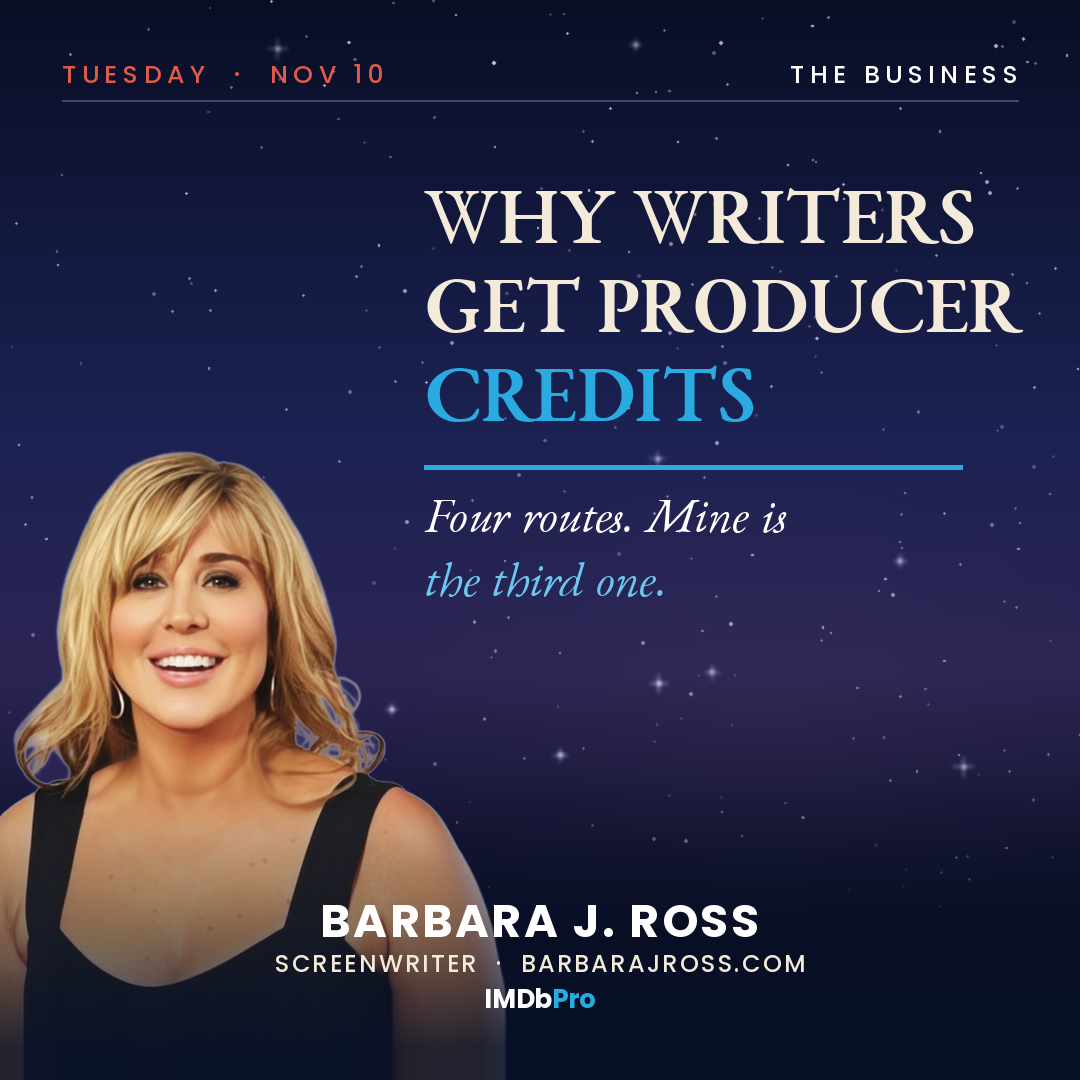
Why Writers Get Producer Credits. Title card by Barbara J. Ross

Watch the credits on almost any movie, opening or closing, and two things stand out. There are a lot of producers. And every so often, one of those producers has the same name as the screenwriter.


When I was starting out I read that as a perk. Somebody with better relationships than mine got a line of billing thrown in on top of the writing fee. It looked like access, which is the thing you assume everybody else has and you don't.


It isn't that. A producer credit is one of the more valuable things a screenwriter can negotiate, and there are specific, repeatable routes to getting one. Final Draft ran a good piece on this at the end of October, written by Edwin Cannistraci, and I read it twice, because on The Cleopatra Project I'll be credited as writer, producer and executive producer. And last year I had no idea this could even happen.


So here's how it works, and then where mine came from.


What the credits actually mean


The Producers Guild sorts feature producing credits, and the differences are real work differences, not politeness.


Producer is the top of it. That person runs the thing from development through delivery. They secure the rights, arrange the financing, hire the writers, attach the talent, supervise the shoot, sign off on the cost reports. A writer usually only holds that credit if the project started with them or they have their own company.


Executive producer is the most common writer deal. The Guild's Code of Credits says an EP credit can reflect a significant contribution to developing the literary property, which in practice often means securing the underlying rights. Films carry several EPs because material changes hands, and an EP credit usually survives even when the person who earned it has moved on before the greenlight.


Co-producer is the broadest category. It covers a lieutenant reporting to the producer, a junior executive who found the script, the person holding the underlying rights, and the original screenwriter who negotiated for it.


Associate producer is given at a producer's discretion for a specific contribution. It shows up less than it used to.


The four routes


You sold a hot spec. When more than one buyer wants a script, the competition is the leverage, and your reps can convert some of it into a credit rather than taking all of it in cash. Alan Ball took co-producer on American Beauty that way. Gregory Weidman and Geoff Tock's sale of Below to Netflix included a provision keeping them attached as writers, which is the same instinct applied to a different problem.


You own the underlying material. This is the strongest position a writer can be in and the one almost nobody uses. If you option the book, buy the article rights, or secure the life rights before you write a word, then whoever wants to make the movie has to come through you. Steven Rogers paid for Tonya Harding's story rights himself and conducted the interviews, and he shares the Produced by on I, Tonya. He didn't ask to be let in. He owned the door.


You built the package. You attached the director, or the actor, or the money. Bill Holderman and Erin Simms wrote Book Club for Diane Keaton and Jane Fonda, got the script back when an option lapsed, and ended up with Produced by credits. Putting a film together is producing work. If you do it, you're producing, and the credit just says so.


There's a sequel provision in your contract. The original writer's deal can guarantee an EP credit, and usually a fee, on follow-ups written by somebody else. Leigh Whannell carries EP on Saw sequels. Kevin Williamson on the 2022 Scream relaunch. If you are writing something you believe becomes a franchise, that clause is worth more than almost anything else you will argue about in the deal.


Television runs on a different ladder. Staff writer, story editor, co-producer, producer, supervising producer, co-executive producer, executive producer, showrunner. The 2023 WGA contract set a separate writer-producer minimum for co-producer and above, at a premium over the story editor rate, but the producer titles themselves are negotiated individually, because the Minimum Basic Agreement covers writing services and nothing else.


Which one is mine


The third.


I own The Cleopatra Project screenplay outright. I wrote it, I registered it, and I have never assigned it, not to my own company and not to the entity the film gets made through. That last part surprises people. B Story Media is mine, The Cleopatra Project LLC is the film's, and the screenplay sits with me personally. It was a deliberate choice and it is the single reason the rest of this conversation is possible.


Then I did the package work. The director came on through me. The agreement that puts her on the picture is a document I negotiated. The entity exists because somebody had to make it exist. Two sequels are planned, which means the sequel provision matters here too.


None of that is glamorous and none of it happened in a meeting I was invited to. It happened in a lot of evenings with contracts I didn't fully understand the first time I read them, and a lawyer's bill, and a few conversations where I had to say out loud that I wasn't signing something yet.


The credit isn't a thank-you for the writing. It's for work I actually did.


The part nobody told me


These are two different systems and they don't talk to each other.


Your writing credit is determined by the WGA. If there's a dispute it goes to arbitration, and arbitration can come back with another writer's name next to yours, or instead of yours, no matter how the pages started.


Your producer credit comes from your contract. It stays where your contract put it. Arbitration doesn't touch it. Which means a producer credit can keep your name on a film in a way a writing credit sometimes can't, and it can carry its own compensation, a producing fee and in stronger deals a piece of the backend.


That's worth knowing when you're deciding what to push for.


What to do with this


If you are early, the useful version of all of this is one question: what do you own on your project right now, on paper?


Not what you wrote. What you own. Is the screenplay registered and unassigned? If you adapted something, do you hold the rights, or did you write on spec from material somebody else controls? Is anyone attached, and did you attach them, and is that in writing? If a producer options this next month, what are you actually bringing besides the pages?


Most of us answer that question badly the first time. I did. The gap between "I wrote a good script" and "I am holding something" is where producer credits live, and it's closable, mostly with unglamorous paperwork done early.


So the writing didn't get me the credit. Owning the script and doing the setup work did.


Source: Edwin Cannistraci, "Why Are Screenwriters Sometimes Credited as Producers?", Final Draft, October 29, 2026. The examples above are his, as is the Producers Guild Code of Credits language and the 2023 WGA contract detail.


I'm a screenwriter and a producer, not a lawyer or an agent. Negotiate your own deal with your own representation.
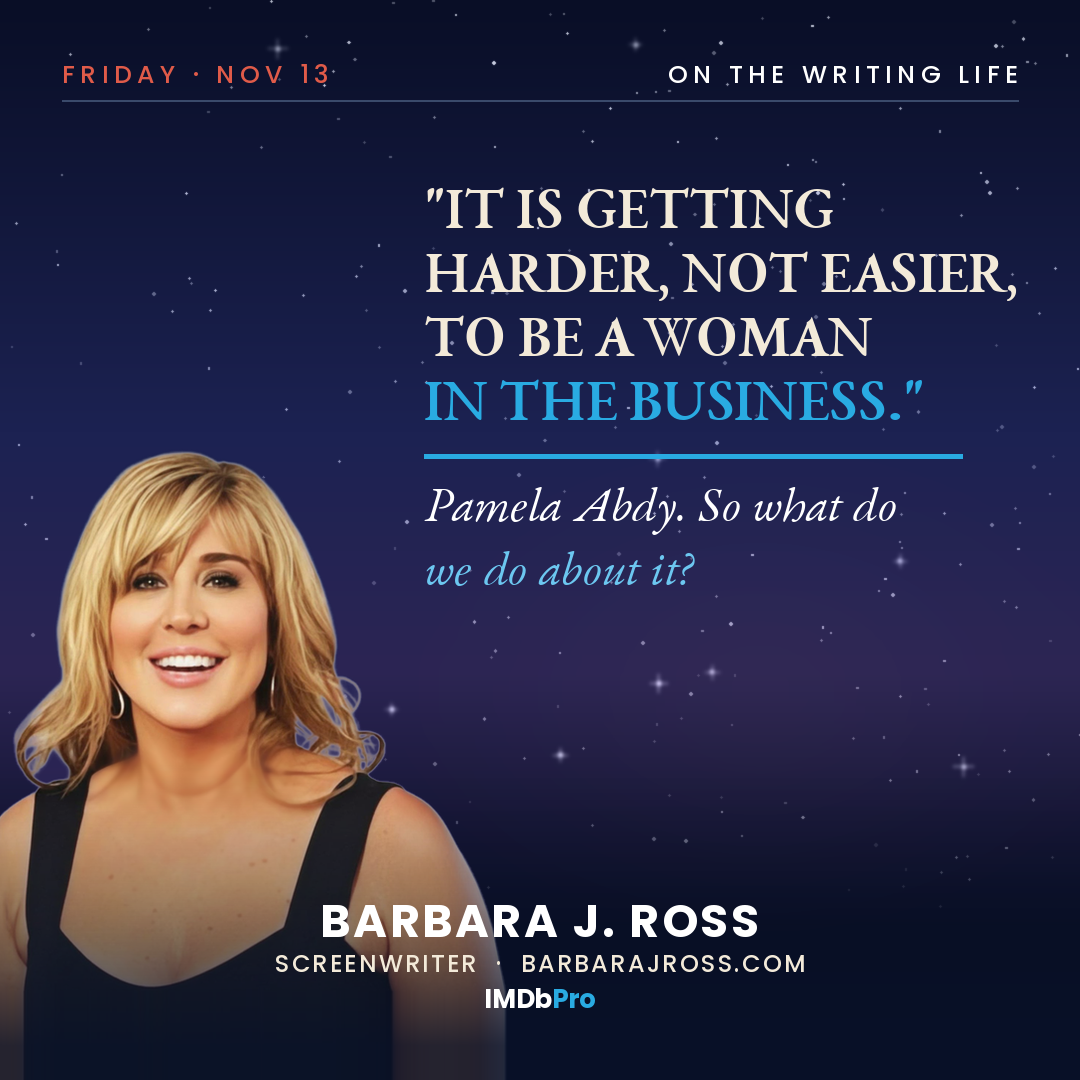
By Barbara Ross • November 13, 2026
Pamela Abdy said it at the WIF Honors. So what do we actually do about it?
By Barbara Ross • November 8, 2026
What you can template, and what you really can't.
Announcement card: Ms. Millennial accepted into the Stage 32 Marketplace, November 2026, approximately the top 1.7 percent
By Barbara J. Ross • November 7, 2026
Ms. Millennial has been accepted into the Stage 32 Marketplace, approximately the top 1.7% of the scripts submitted. A screenplay by Barbara J. Ross.
By Barbara Ross • November 6, 2026
The premise and the arc end up in the same sentence.
By Barbara Ross • November 6, 2026
Octavia Butler wrote it to herself in 1988, twenty years into rejection slips and temp jobs.
By Barbara Ross • November 5, 2026
Give them something to do that only they would do.
By Barbara Ross • November 4, 2026
The work itself is the only payment you're guaranteed.
By Barbara Ross • November 3, 2026
A stunt coordinator will rewrite your moves. Nobody is going to rewrite your reasons.
By Barbara Ross • November 2, 2026
A camera records what is there. A negative only plays when the absence has a visible shape.
By Barbara Ross • November 1, 2026
A spending quota changes how much money moves, not who the buyer can already find.
By Barbara Ross • October 31, 2026
Pick one dark trait as the engine, write the other two weaker, and give them something they are good at.
By Barbara Ross • October 30, 2026
Two Virginia Woolf lines going around right now are not hers, and the real one is better.
By Barbara Ross • October 29, 2026
They decide what your movie looks like, and you hire one in prep, earlier than you think.
By Barbara Ross • October 28, 2026
Most of them do nothing for your career and a few do everything, and the difference is who is in the building.
By Barbara Ross • October 27, 2026
It's a rights market, not a script market, so a spec has nothing to transact there.
By Barbara Ross • October 23, 2026
She stopped waiting for better parts and built a company to make her own.
By Barbara Ross • October 21, 2026
You already are one, whether you admit it or not.
By Barbara Ross • October 20, 2026
Find out whether you have a story-length problem or a writing-length problem before you cut anything.
By Barbara Ross • October 19, 2026
Build the midpoint as a rehearsal for the ending, the same choice at a lower price.
By Barbara Ross • October 17, 2026
Reach on a social platform is rented, and a list is owned.
By Barbara Ross • October 16, 2026
Being first is timing and somebody's open door. Lasting is the craft.
By Barbara Ross • October 15, 2026
Repetition is how you teach an audience the rules of your story, and an audience that knows the rules can run ahead of you.
By Barbara Ross • October 14, 2026
The affair confrontation is an information scene, and the first line out of the guilty character's mouth is a question.
By Barbara Ross • October 13, 2026
There are two kinds of fake ticking clock, and they run on different rules.
By Barbara Ross • October 13, 2026
A package is what lets somebody else write a check. The cast list is the piece that moves the number.
By Barbara Ross • October 9, 2026
The citation says new forms, which means the unclassifiable part is the part they rewarded.
Social card for the post, screenwriter Barbara J. Ross beside the headline She Was First. That Wasn'
By Barbara J. Ross • October 9, 2026
Anita Loos was the first woman staff screenwriter in Hollywood. The more interesting fact is the sixty eight years of work that came after.
Social card for the post, screenwriter Barbara J. Ross beside the headline Intercutting Scenes
By Barbara J. Ross • October 8, 2026
An intercut is not a transition. Three questions that tell you whether you have one, with The Godfather and The Silence of the Lambs as proof.
Social card for the post, screenwriter Barbara J. Ross beside the headline Writing the Text Message
By Barbara J. Ross • October 7, 2026
Text scenes fail when you write the transcript. Write the gap instead: the typing indicator, the delete, the message nobody answers.
Social card for the post, screenwriter Barbara J. Ross beside the headline The Oldest Thing in the F
By Barbara J. Ross • October 6, 2026
Your opening scene is the oldest thing in the file. Four questions to ask it, with The Godfather and Sunset Boulevard as the working examples.
Social card for the post, screenwriter Barbara J. Ross beside the headline Do You Pay the Sales Agent and the Distributor?
By Barbara J. Ross • October 5, 2026
Part two on film sales: when a sales agent commissions the license fee, when a distributor's margin is already priced in, and where the fees stack.
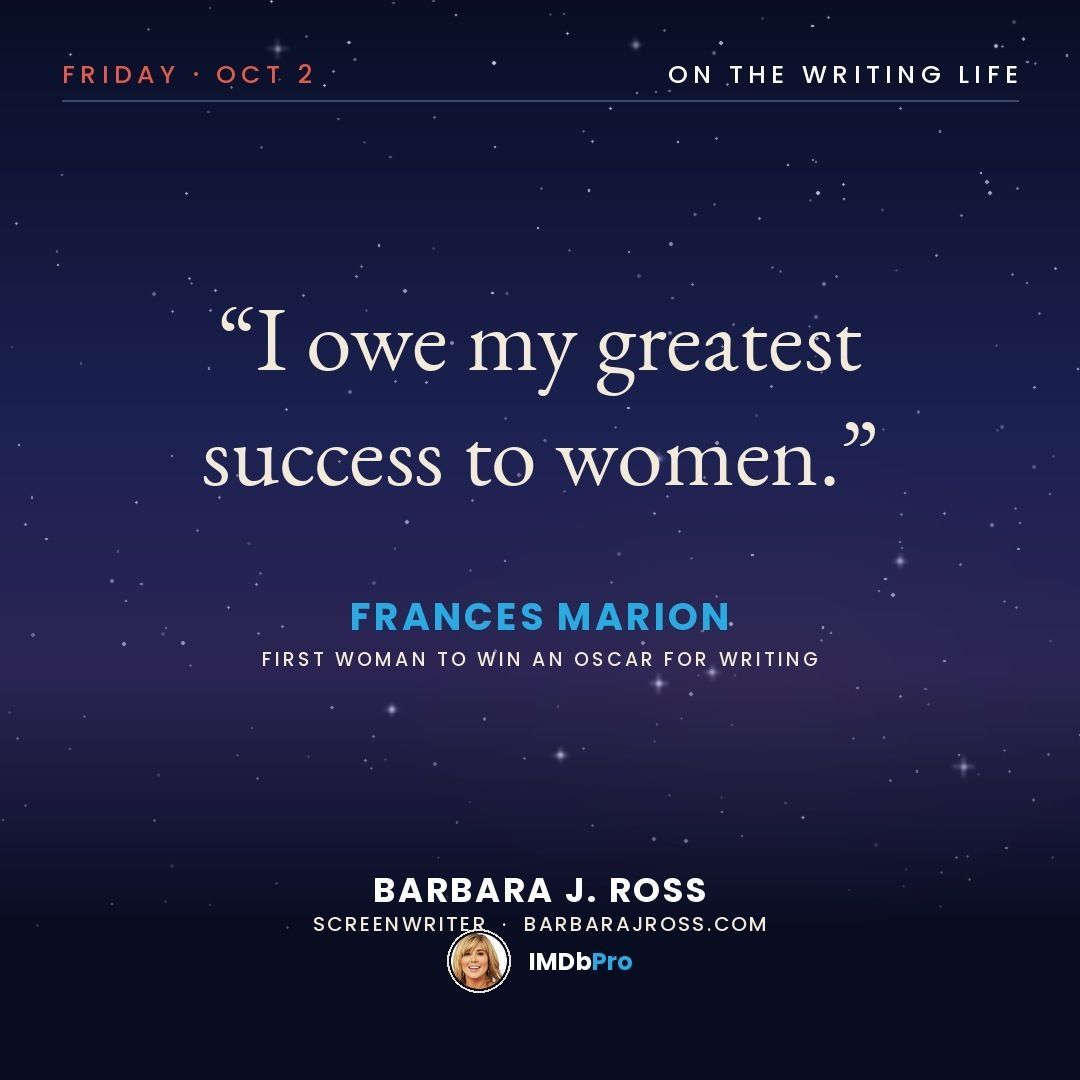
Quote card reading I owe my greatest success to women, Frances Marion, with a photo of screenwriter Barbara J. Ross
By Barbara J. Ross • October 2, 2026
Frances Marion was the highest paid screenwriter in Hollywood and the first woman to win an Oscar for writing. A woman gave her the first job.
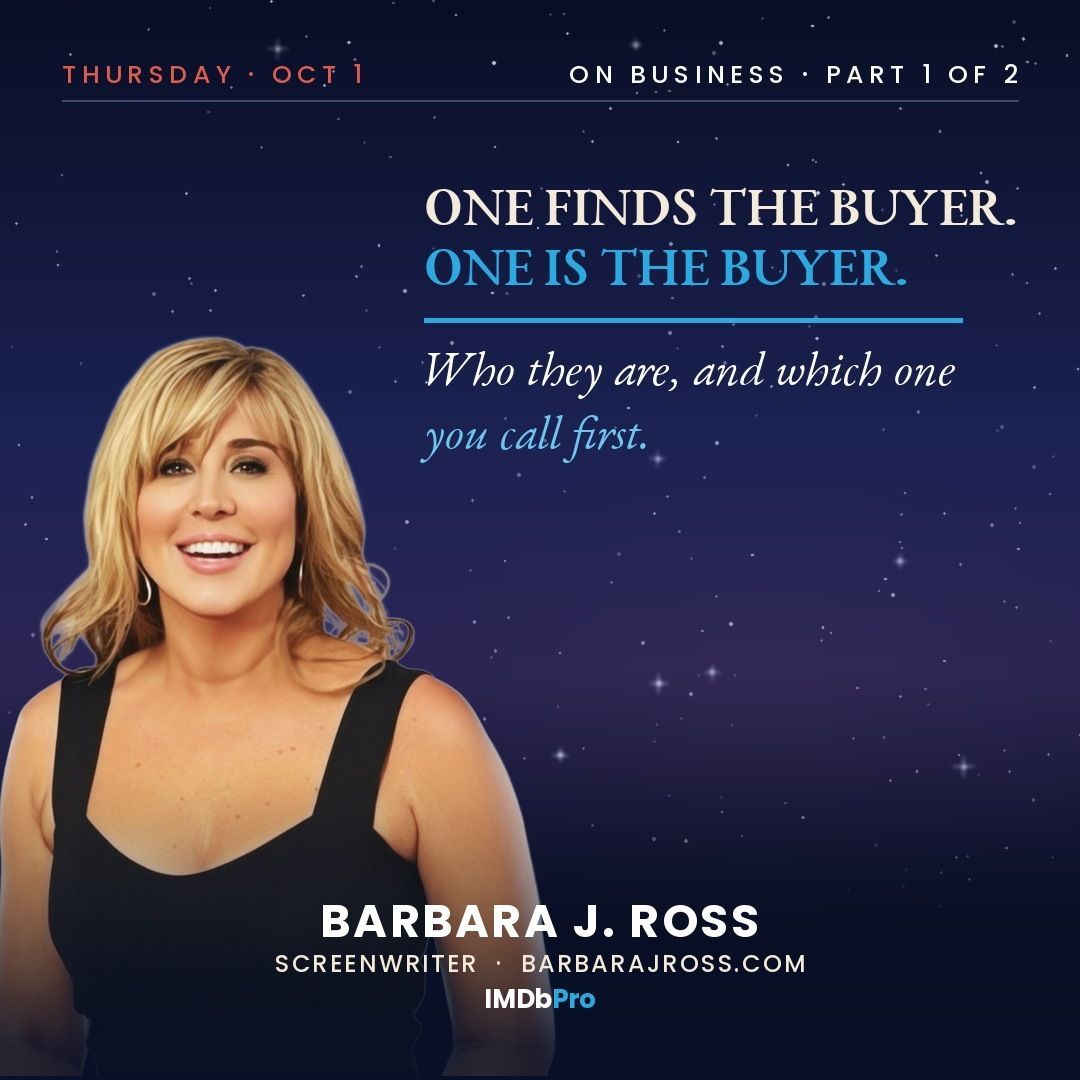
Social card reading One Finds the Buyer, One Is the Buyer, with a photo of screenwriter Barbara J. Ross
By Barbara J. Ross • October 1, 2026
A sales agent works for you. A distributor is the buyer. Calling the wrong one first costs first-time filmmakers real money.
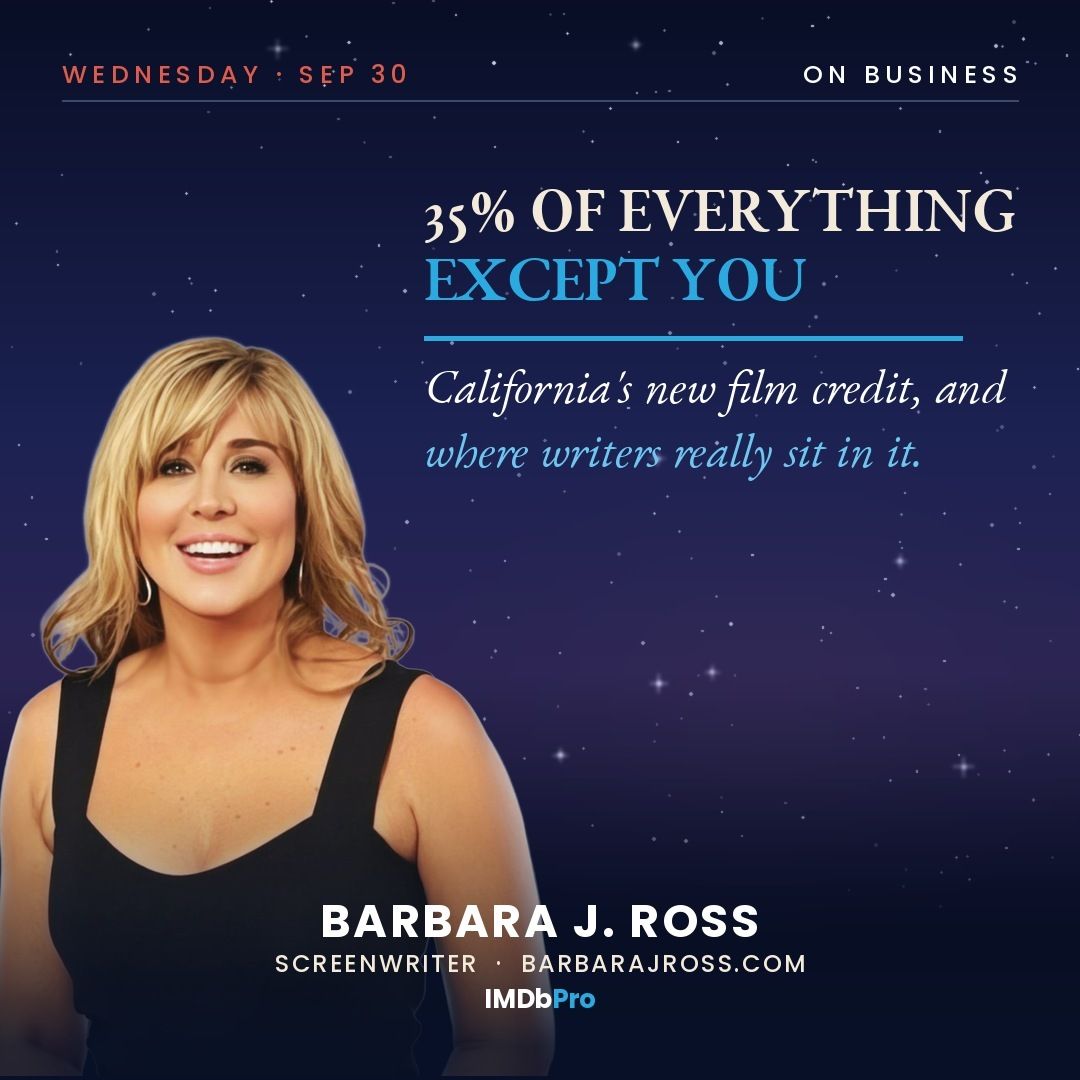
Social card reading 35% of Everything Except You, with a photo of screenwriter Barbara J. Ross
By Barbara J. Ross • September 30, 2026
California’s film credit now pays up to 35% on a $750 million pool. Writers are non-qualified spend, and here is why that still matters.
Social card reading NDA or Not to NDA, with a photo of screenwriter Barbara J. Ross
By Barbara J. Ross • September 29, 2026
Almost nobody will sign a writer’s NDA. What a submission release actually says, and where to protect the work instead.
Quote card: Above all, be the heroine of your life, not the victim - Nora Ephron, on the Barbara J. Ross screenwriting blog
By Barbara J. Ross • September 25, 2026
Nora Ephron told Wellesley graduates to be the heroine, not the victim. For screenwriters, that line is a business instruction, not a sentiment.
Light blue blog card reading Ticking Clocks, tagged On Screenwriting, with a photo of Barbara J. Ross
By Barbara J. Ross • September 24, 2026
A ticking clock is a deadline the audience can count. Not a mood, a number that gets smaller while they watch. A deadline with no consequence is a calendar.
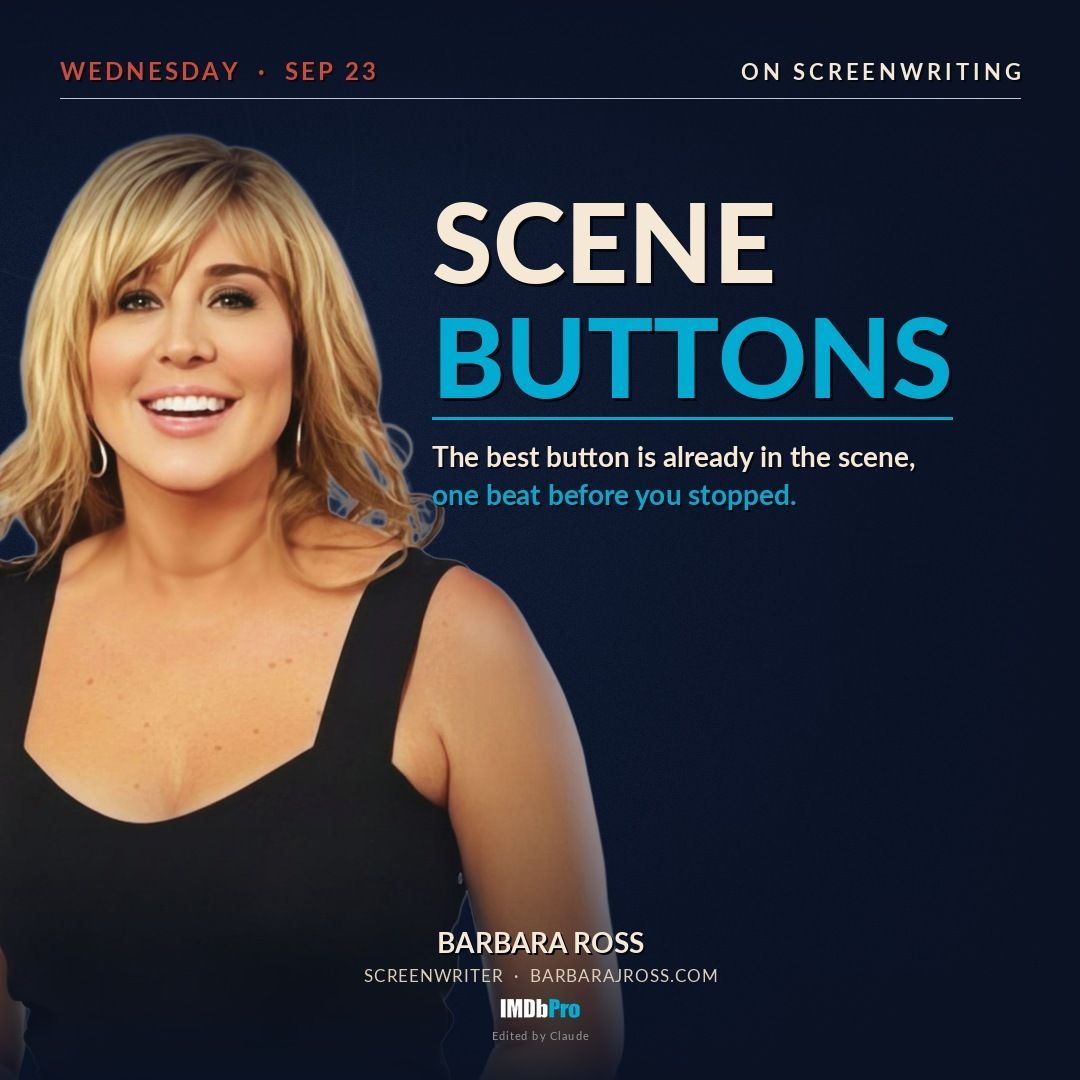
Light blue blog card reading Scene Buttons, tagged On Screenwriting, with a photo of Barbara J. Ross
By Barbara J. Ross • September 23, 2026
A button is the last beat of a scene, the line that makes the cut feel decided. The best one is already in the scene, one beat before you stopped.
Light blue blog card reading Writing the Phone Call, tagged On Screenwriting, with a photo of Barbar
By Barbara J. Ross • September 22, 2026
A phone call takes away everything you usually use. It's only half a scene, and you write the other half: what each person does, and what each one can't see.
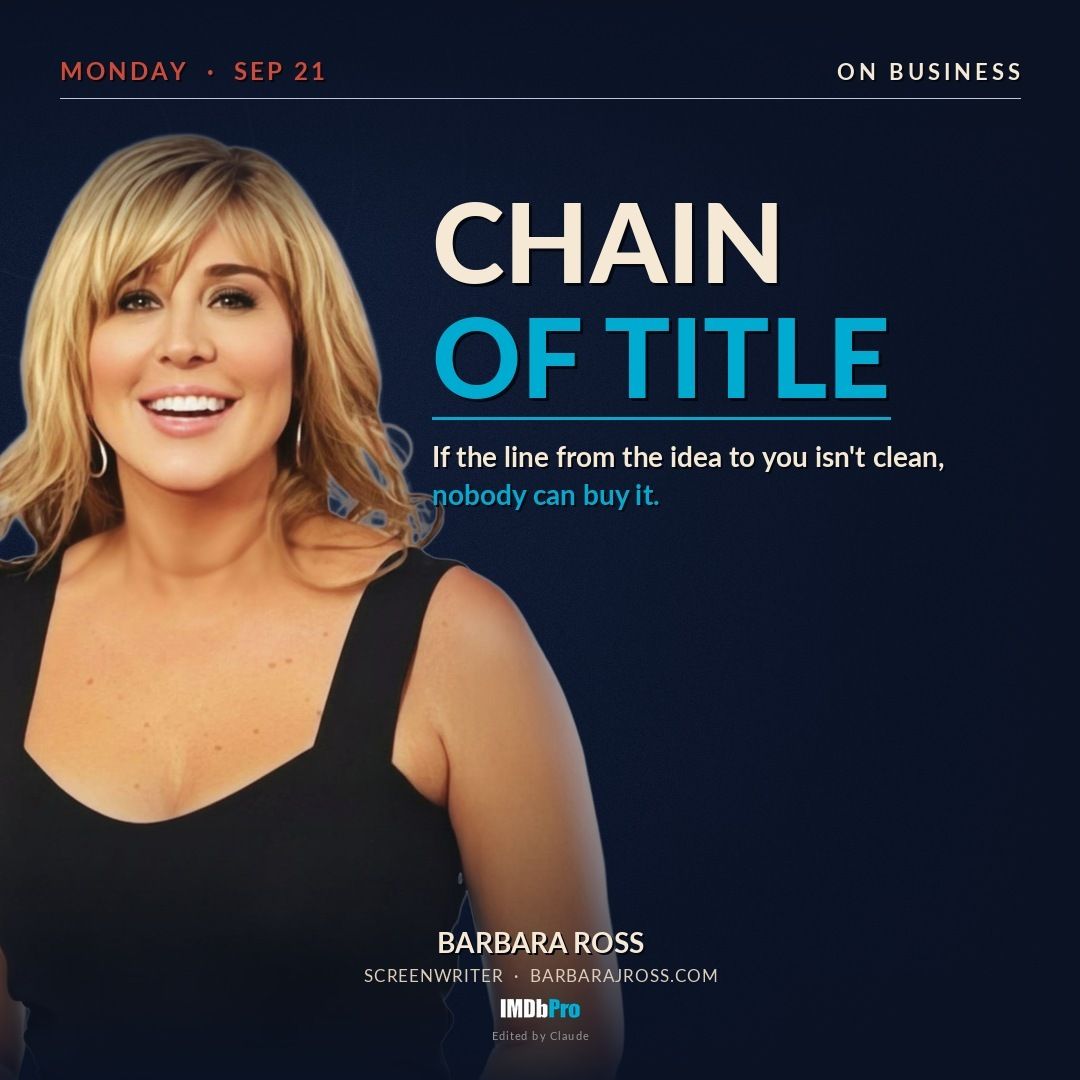
Light blue blog card reading Chain of Title, tagged On Business, with a photo of screenwriter Barbar
By Barbara J. Ross • September 21, 2026
Chain of title is the paper trail that proves who owns the story. If a lawyer can't draw a clean line from the idea to you, the script can't be bought.
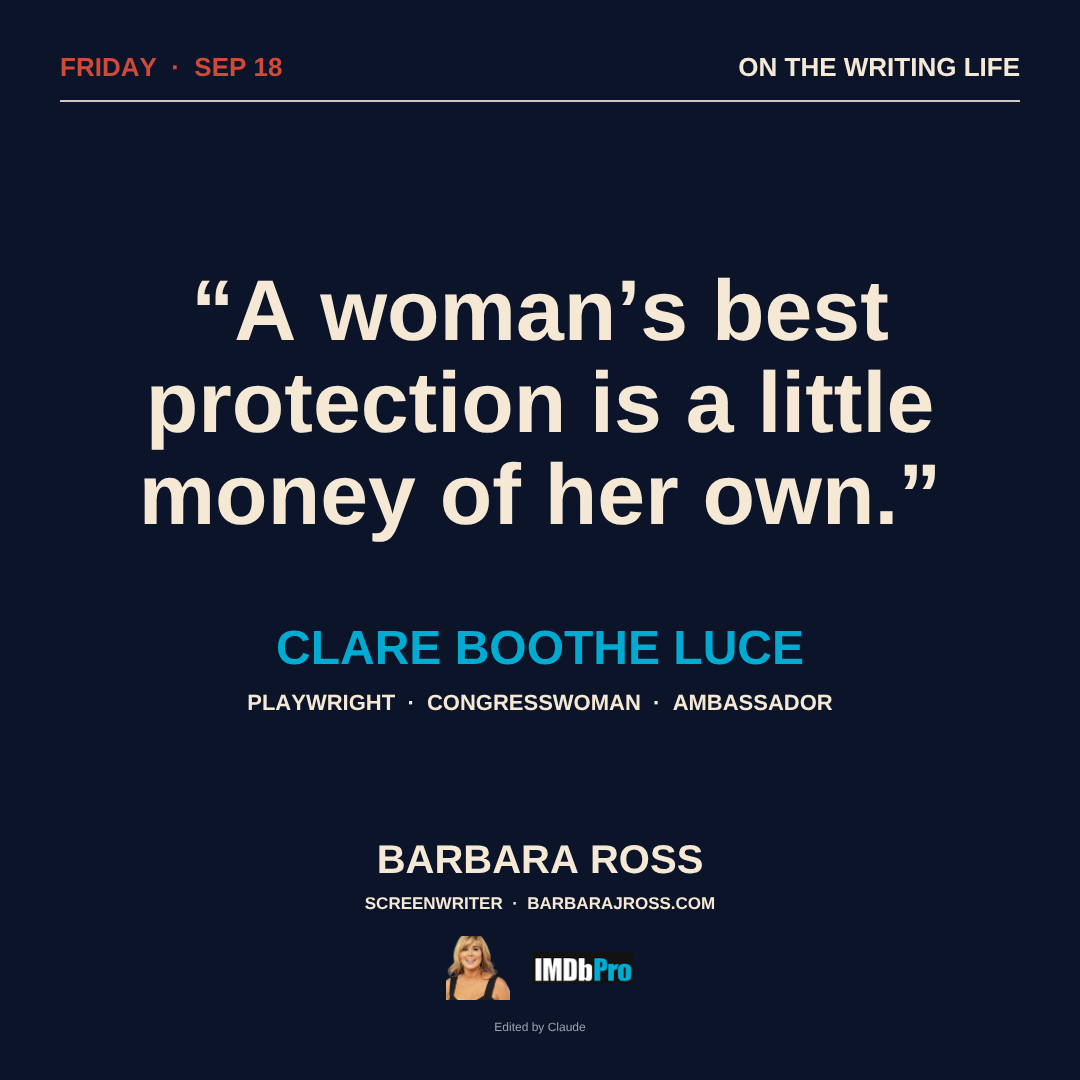
Dark blue quote card reading A woman's best protection is a little money of her own, credited to Cla
By Barbara J. Ross • September 18, 2026
Clare Boothe Luce knew what it took to get into those rooms. Having your own money isn't about being rich. It's about being able to say no and to walk out.
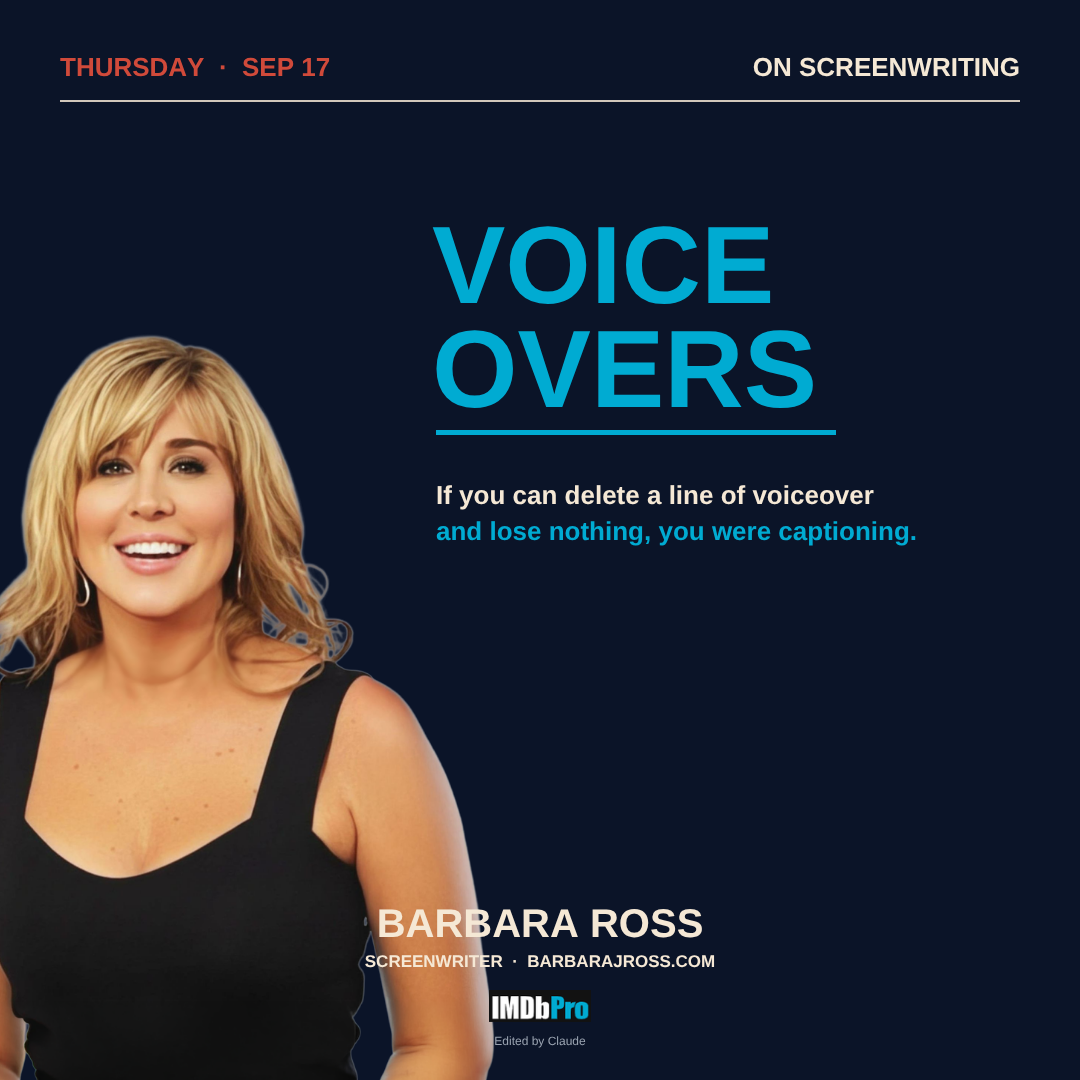
Blog card reading Voiceovers, with a photo of screenwriter Barbara Ross on a dark blue background
By Barbara J. Ross • September 17, 2026
Voiceover isn't cheating, but captioning the frame is. Goodfellas and Sunset Boulevard show the difference, and one test tells you which one you wrote.
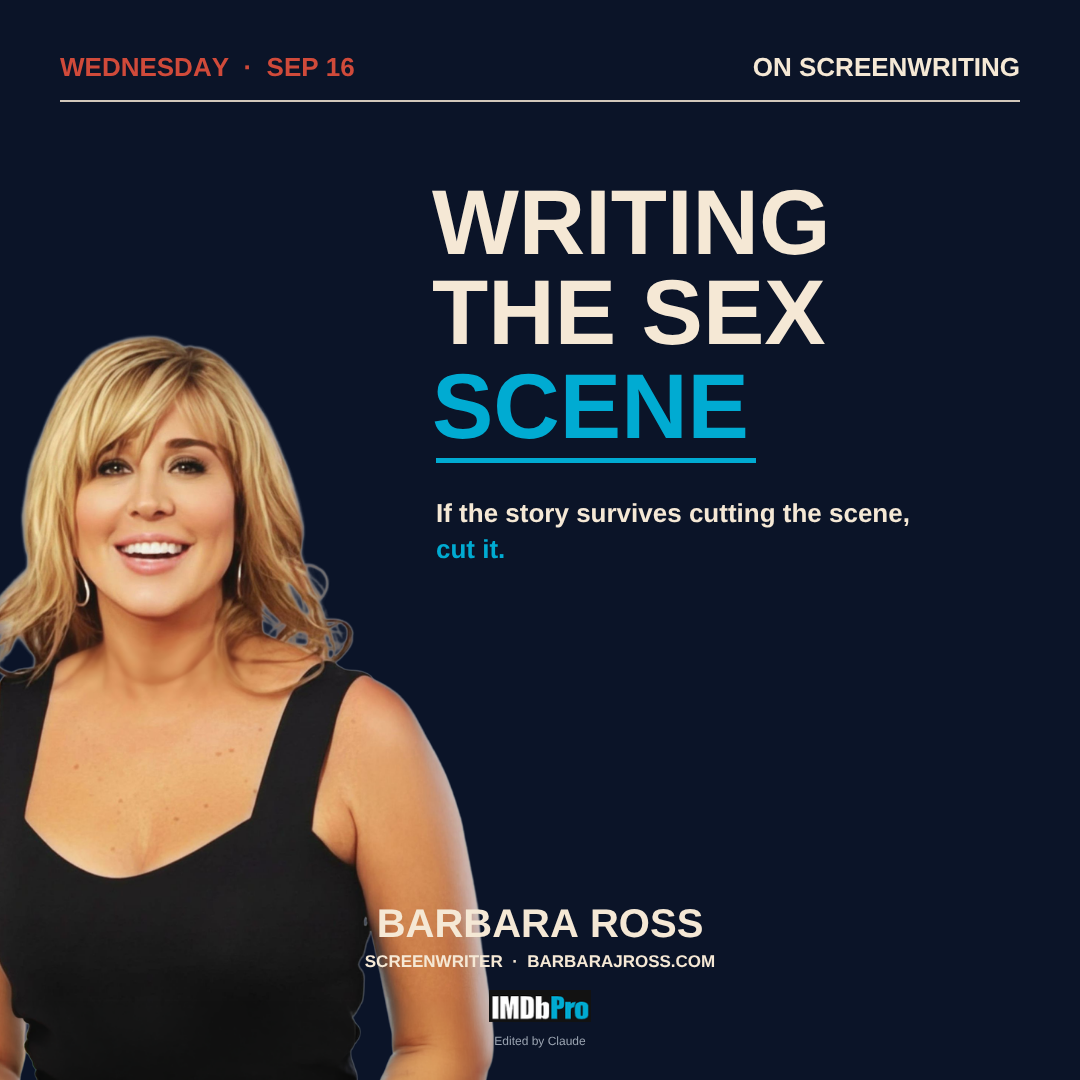
Blog card reading Writing the Sex Scene, with a photo of screenwriter Barbara Ross on a dark blue ba
By Barbara J. Ross • September 16, 2026
The good sex scenes are negotiations. Write the decision, not the choreography, and remember the agent and the line producer read the pages too.
Blog card reading What the Deal Memo Locks In, with a photo of screenwriter Barbara Ross on a dark b
By Barbara J. Ross • September 15, 2026
The deal memo takes an afternoon and the lawyers argue from it for a year. Credit, rewrite steps, bonus triggers, reversion: know your three before the call.
Blog card reading Know Who You're Pitching, with a photo of screenwriter Barbara Ross on a dark blue
By Barbara J. Ross • September 14, 2026
Lenders don't buy scripts. Fifteen minutes of research tells you whether the name on your desk is equity or debt, and whether your pitch has any chance.
Quote card reading They called you difficult, you were just the only one telling the truth, by Barbara J. Ross
By Barbara J. Ross • September 11, 2026
Difficult is what they call you when you ask who is paying and want the credit in writing. It describes the inconvenience, not your temperament.
Social card reading Writing Twists That Don't Cheat, with a photo of screenwriter Barbara J. Ross
By Barbara J. Ross • September 10, 2026
Withheld information is not a twist, it is a trick. A real twist uses what the audience already had and shows them they read it wrong.
Social card reading What's On the Nose, with a photo of screenwriter Barbara J. Ross
By Barbara J. Ross • September 9, 2026
On-the-nose dialogue kills a scene because it leaves the audience nothing to do. The fix is not vagueness. It is giving the character something else to want.
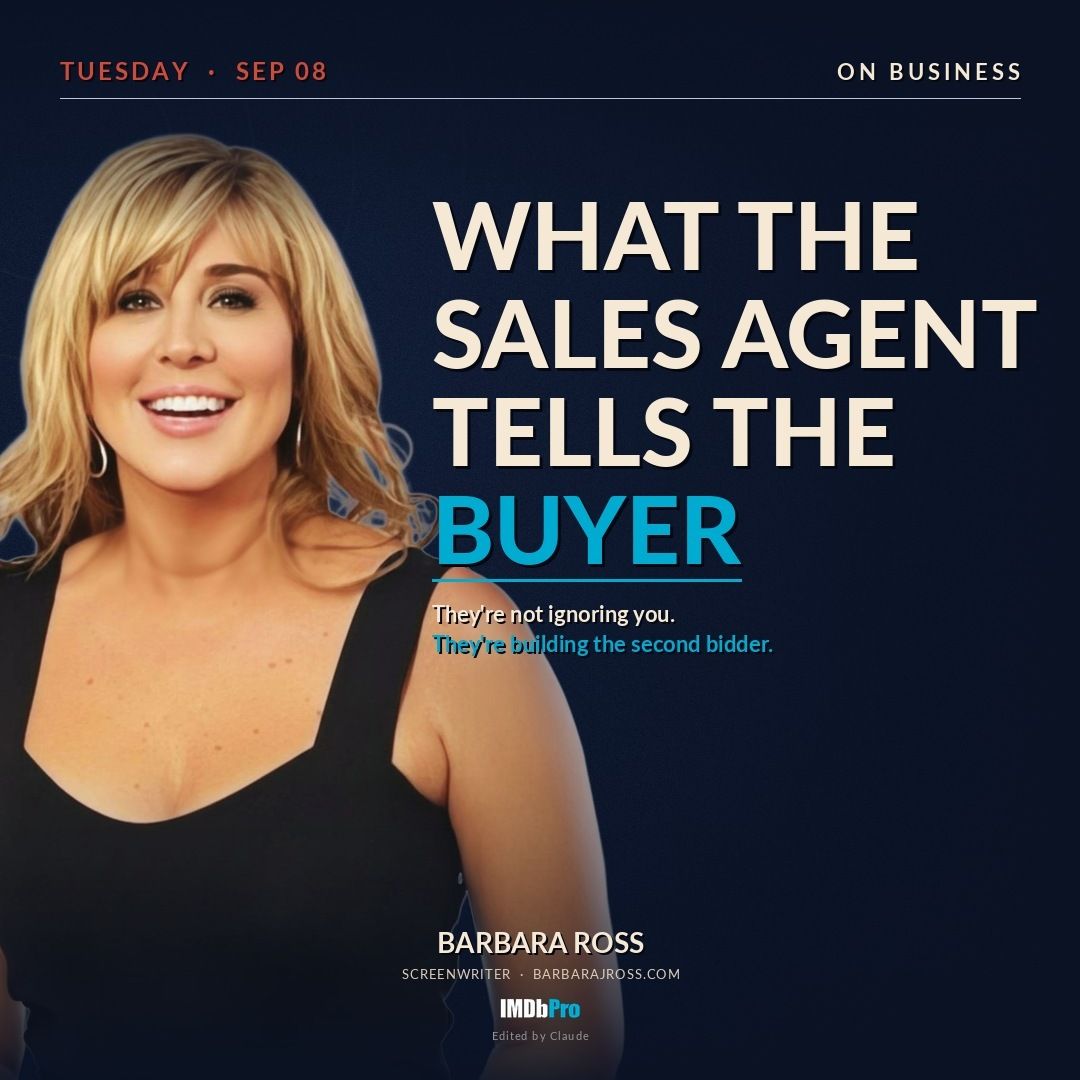
Social card reading What the Sales Agent Tells the Buyer, with a photo of screenwriter Barbara J. Ross
By Barbara J. Ross • September 8, 2026
The buyer asks who else is looking. That answer, not your draft, is what moves the number. What agents are really managing is scarcity.
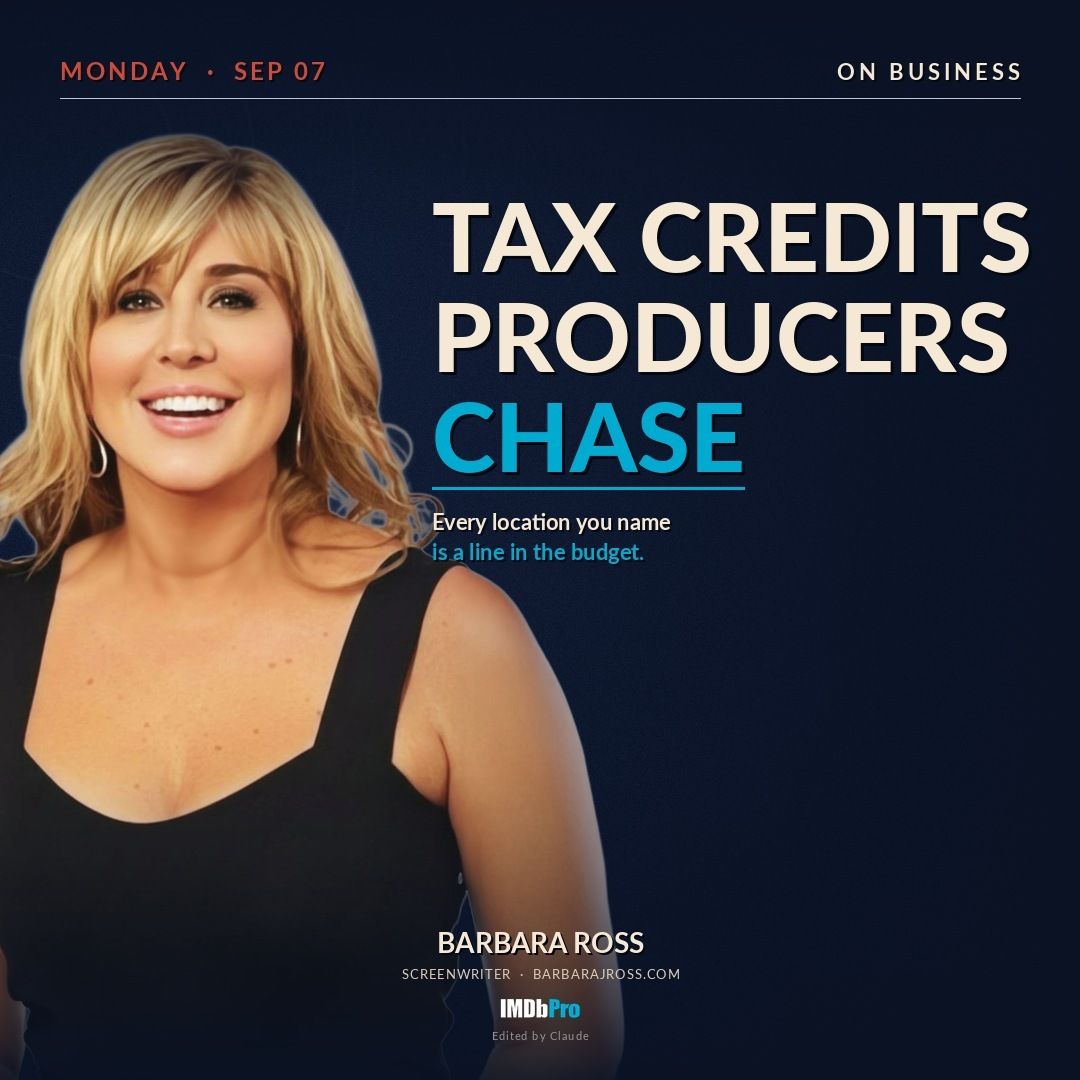
Social card reading Tax Credits Producers Chase, with a photo of screenwriter Barbara J. Ross
By Barbara J. Ross • September 7, 2026
Georgia pays up to 30 percent back on qualified spend. That credit decides where your movie shoots, often before anyone reads your pages.
Show More