Find out whether you have a story-length problem or a writing-length problem before you cut anything.
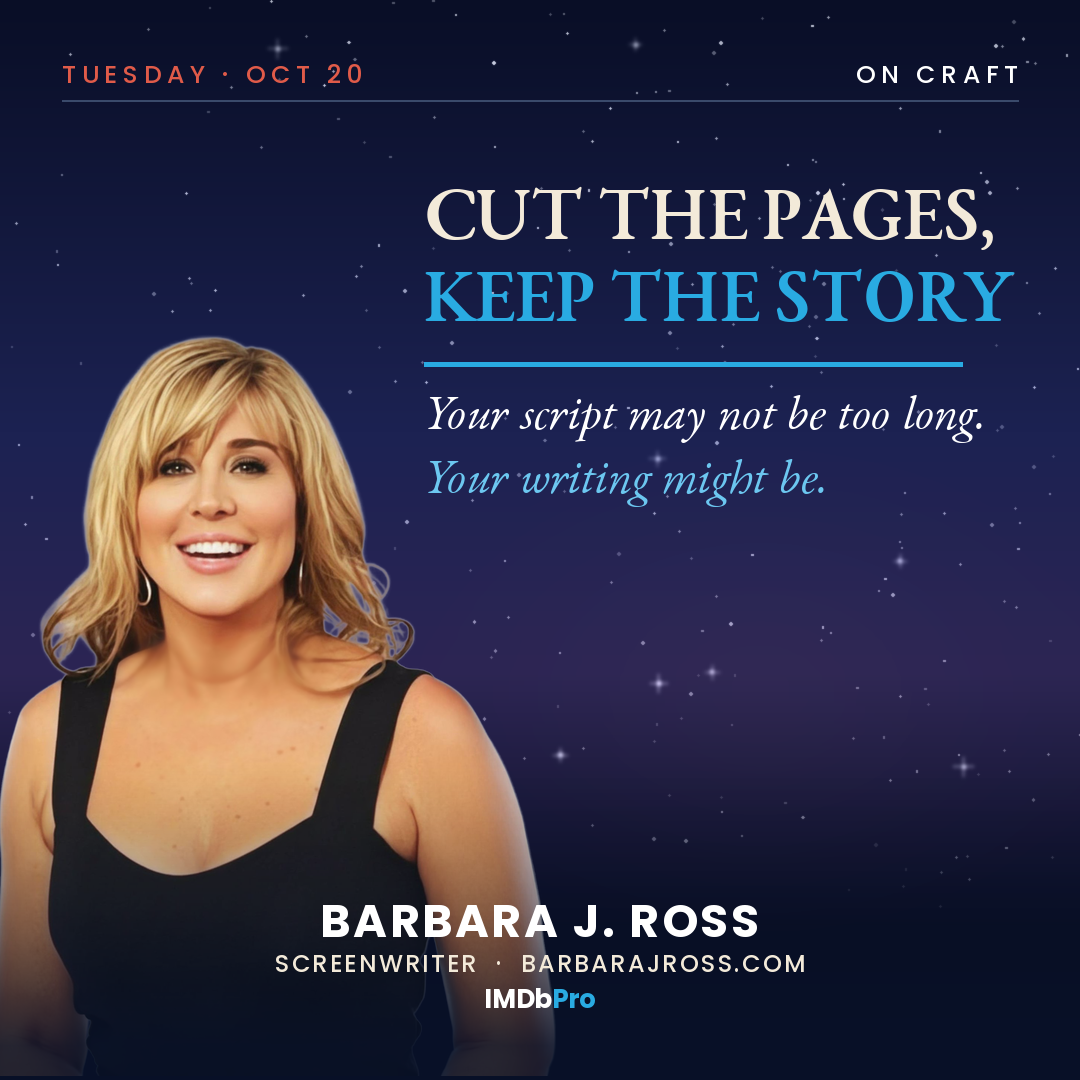
TL;DR. Find out whether you have a story-length problem or a writing-length problem before you cut anything, because they need opposite fixes. Build a beat sheet with one sentence per scene saying what that scene is for. If the scenes earn their places, the pages are hiding in the writing: enter scenes late and leave early, cut information you delivered more than twice, merge supporting characters who do the same job, and combine beats you love into single scenes instead of deleting them.
Is my script too long, or is my writing too long?
That's the question to answer first, and almost nobody asks it. A script runs long either because the story is too big, too many scenes and subplots and characters, or because the writing is too fat for the story it's carrying. Two writers can both hand you 120 pages and need completely different fixes.
Build a beat sheet with one sentence per scene, and make the sentence state the scene's purpose. If almost every scene earns its place, you don't have a story problem. You have a compression problem, and that one is easier to solve.
Spec scripts generally live between 90 and 115 pages. So if you're at 127 and every scene is doing a job, your twenty pages are hiding in the writing, not in the plot.
Where do the easiest pages come from?
The tops and tails of scenes. We write the whole thing, including the parts nobody needs. The greeting, the walk through the door, the explanation of what just happened and what's coming next.
Cut the first line and the last line of every scene and see how many survive the loss. Start a scene at the last moment the audience can still follow, and end it the moment the information lands, the argument peaks, or the decision gets made. If someone is driving to the police station, skip the drive and start inside the station. Your audience will keep up.
How do I find repetition I can't see any more?
Track single pieces of information through the draft. A detective learns about the threats, tells her partner, briefs the captain, then sits with the family. That's four scenes delivering one fact. We do it because we're afraid it didn't land the first time.
It shows up three ways. In beats, where several conversations in several locations could be one conversation in one. In characters, where two supporting players serve the same function in the story, which means you have one character and a spare. And in dialogue, where two speeches make the same argument.
Once something is clearly established, trust the audience with it.
How much can I compress description and dialogue?
More than feels comfortable. A paragraph of prison cell with the dripping water and the moonlight through rusty bars becomes "Dark. Wet. Shadows overcome any source of light."
Dialogue goes the same way. "I don't know, I guess what I'm trying to say is maybe we shouldn't go there tonight" is "We shouldn't go tonight."
Everything you cut makes what's left hit harder.
What if I don't want to lose the good parts?
Then stop deleting and start combining. This is the technique that saves the material you actually like.
Say you have three beats you love. An argument with a spouse, a phone call that turns the plot, and the moment your lead notices someone watching the house. You don't have to pick one. Put the argument in the car, let the call come in during it, and have her catch the watcher through the window when she gets home. Three beats, one scene, and the scene is better than any of them were alone.
Does the line spacing trick work?
Final Draft will let you tighten line spacing under Document, Page Layout, Options, and the article is upfront that it's cosmetic rather than a substitute for editing. So am I. People who read scripts all day can tell, and a 115 that looks like a squeezed 127 reads worse than an honest 120.
The page-cutting checklist
Did you build the beat sheet first, one sentence per scene, saying what each scene is for?
Do you know whether you have a story problem or a writing problem?
Have you cut the first and last line of every scene to see which ones survive?
Where did you deliver the same information more than twice?
Do any two supporting characters do the same job?
Can three beats you love happen in one scene instead of three?
Is the result an honest page count, or a squeezed one?
The goal was never a shorter script. It's the same story landing harder on fewer pages.
---
Sources. Ken Miyamoto, "How to Cut Pages Without Losing Story," Final Draft, 22 September 2026.