She stopped waiting for better parts and built a company to make her own.
TL;DR. Ida Lupino stopped waiting for better parts and built a company to make her own, and the full version of that story is less tidy and far more useful than the poster version. It began as Emerald Productions, named for her mother's stage name, with her husband Collier Young and a clothing magnate called Anson Bond, and became The Filmakers in 1949 once the screenwriter Malvin Wald bought Bond out. She never set out to direct. The credited director of their first picture had a heart attack days into the shoot, she finished it and kept her name off it, and from there she directed six features in about five years on budgets near two hundred thousand dollars. The company died the moment distribution walked away, and that's the part worth studying hardest.

What exactly was The Filmakers, and who paid for it?

An independent outfit with three officers and no studio behind it. Collier Young was president, Lupino vice-president, Malvin Wald the business manager. The stated purpose was to produce, direct and write low-budget, issue-driven pictures, which meant shooting fast and cheap. Not Wanted cost one hundred and fifty-four thousand dollars and shot in under thirty days. Hard, Fast and Beautiful came in just under two hundred thousand.

Not Wanted. Paul Jarrico and Ida Lupino wrote it, from a story by Jarrico and Wald, and Elmer Clifton has the directing credit. A few days into the shoot Clifton had a heart attack. Lupino directed the rest of it and took no credit. Film Classics released it in June 1949 and it never earned back its negative cost.

The money that followed came from Howard Hughes, who had bought RKO. He put up two hundred and fifty thousand dollars a picture in a negative pickup covering three features, which bought The Filmakers national distribution. Whether it also left Lupino in control depends on who you read. One account has the arrangement preserving the company's creative control outright. Turner Classic Movies says that deal is precisely what stripped the company of control and profits and began its decline. Both can be true of an arrangement like that, and both are worth knowing before you sign one.

What did she make that the studios wouldn't?

The list is the argument.

Never Fear, her first credited directing job, is about a dancer struck by polio, loosely drawn from her own illness. Outrage, which Lupino wrote with Malvin Wald and Collier Young, is about a bookkeeper raped by a coworker, and the censorship of the period meant the script could only call it a criminal assault. The attack happens off screen. The word is never said out loud. Hard, Fast and Beautiful is about a mother pushing her daughter through tournament tennis and the machinery that chews up young athletes. The Bigamist, which Young wrote and Lupino directed and acted in, sets a career woman against a homemaker and declines to pick.

The cost shows up in the reviews. A.H. Weiler in the New York Times credited Outrage with restraint and a modicum of courage, then said it lacked punch and conviction. Philip K. Scheuer in the Los Angeles Times went after its philosophical maturity and called the subject unattractively handled. Outrage went into the National Film Registry in 2020, seventy years later.

Why did the company die?

Distribution. Not talent, not taste, not nerve.

RKO declined to renew after The Bigamist and passed on the finished film, so The Filmakers released it themselves through an outfit called the Filmakers Releasing Organization. Without a major's national booking apparatus the picture never reached enough theaters, and the company folded. Accounts put the end at 1953, 1954 or 1955 depending on who's counting, which tells you how quietly it went. Eight features in all, six of them directed by her.

Notice the sequence, because it repeats. She solved writing. She solved producing. She solved directing, under emergency conditions. What she couldn't solve was getting the work in front of people, and that's what killed it.

What does "first woman to direct an American film noir" actually mean?

Less than the sentence implies, and still plenty.

The Hitch-Hiker. Ida Lupino and Collier Young wrote it, by then her former husband and still her partner, Lupino directed and Nicholas Musuraca shot it, seventy-one minutes on two hundred thousand dollars in five weeks around Lone Pine, California. The story came from Daniel Mainwaring, who got no screen credit because of the blacklist, adapted by Robert L. Joseph, and built on William Edward Cook Jr., a twenty-two-year-old whose 1950 spree included the Mosser family murders in Oklahoma. The Production Code office and the Federal Bureau of Prisons made them fictionalize it and drop the killings.

Now the precision. It's the first noir directed by a woman to get a mainstream American release, and historians hedge even that with "probably." Edith Carlmer directed a Norwegian noir, Doden er et kjaertegn, in 1949. The critic John Krewson has called The Hitch-Hiker the only true noir directed by a woman, which is an opinion rather than a count. It went into the National Film Registry in 1998 and it's in the public domain in the United States, so you can watch it tonight for free, and you should.

The rarer record is The Bigamist, cited as the first American sound feature in which the female star directed herself.

Why did television matter more than the company did?

Because it lasted twelve years and the company lasted five.

She made her television directing debut in 1956 with an episode of Screen Directors Playhouse called "No. 5 Checked Out," and worked steadily through 1968. The counts vary, from over sixty-five episodes to more than a hundred across better than thirty series. Alfred Hitchcock Presents. The Untouchables. The Fugitive. Have Gun, Will Travel. The Virginian. Thriller. Bewitched. Gilligan's Island. She was the only woman to direct an episode of The Twilight Zone, "The Masks," in 1964, and she had acted in an episode in 1959, which makes her the only person to do both. She also created and starred in her own series, Mr. Adams and Eve, in 1957 and 1958.

Her own account of all this was cheerful. "I loved shooting for television," she said. "Each show was a new challenge to Mother!" The back of her director's chair read Mother of All of Us. When she had to raise money she called herself a bulldozer. And the line everyone quotes, "you do not tell a man; you suggest to him," comes from a 1967 essay she wrote for Action, the Directors Guild magazine. Fourteen years after The Hitch-Hiker she was still doing that arithmetic in public.

What transfers from 1949, and what doesn't?

The shape doesn't transfer. You don't need an incorporated company with three officers to make something now, and production costs have fallen in a way she'd have found hard to believe.

The chokepoint transfers exactly. She could deliver a feature for a hundred and fifty-four thousand dollars in under a month and still couldn't get it seen, because somebody else owned the pipes. That hasn't changed, it's only been renamed. Festival programmers, sales agents, platform acquisitions and recommendation algorithms are the 1949 booking apparatus with better branding. So the move isn't to incorporate. Whatever you build has to carry its own route to actual people, which in 2026 usually means a list, an audience and a body of work with your name on it.

And the second thing, which is the one I keep coming back to. She didn't become a director by deciding to. She became one because she was already in the room when somebody else couldn't do the job. Being in the room is the part you control.

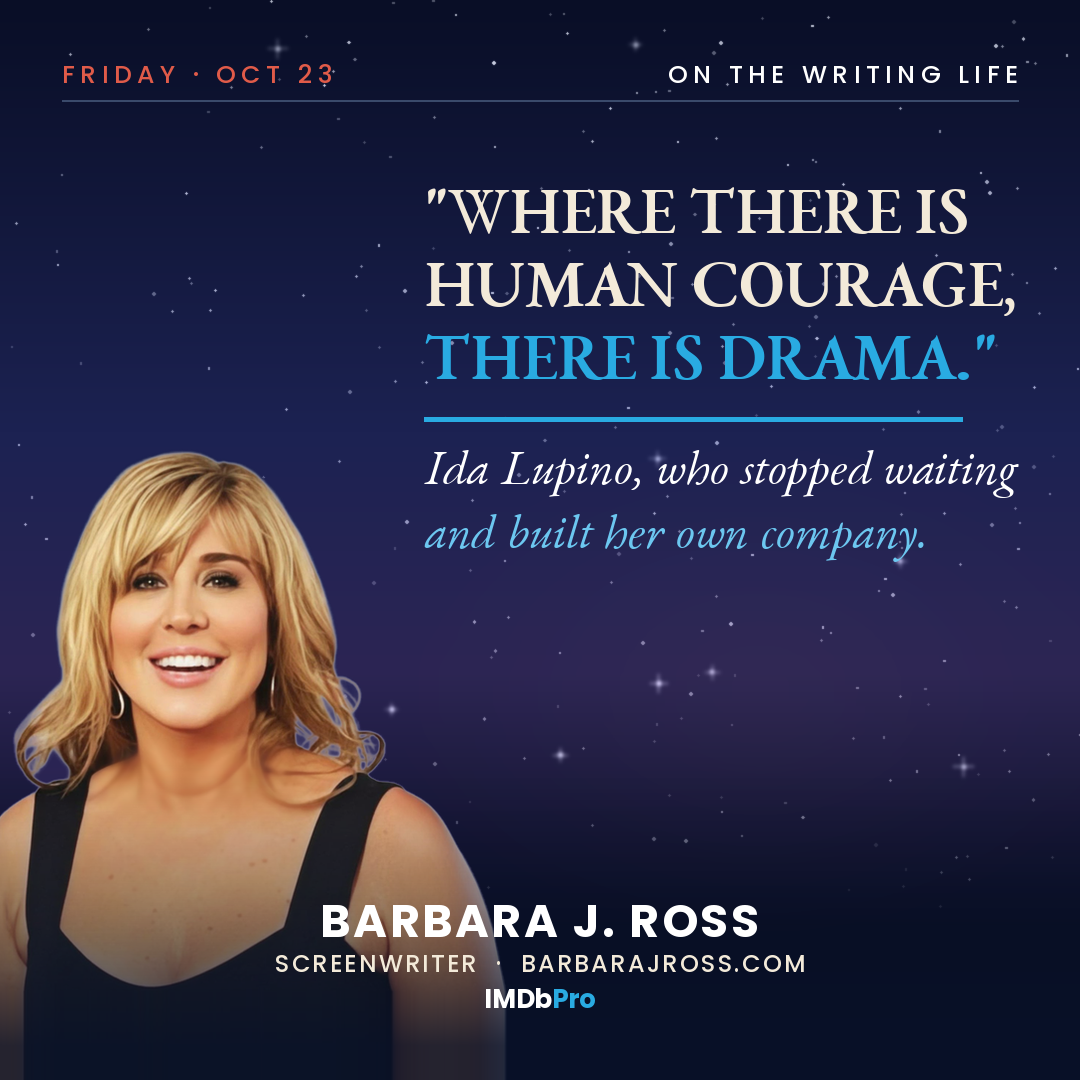
"Where there is human courage, there is drama," she said. "When everyday people fight for life and love, you have the very essence of heroism. I tried to capture this in every film I directed." She meant it about what ends up on screen. It happens to describe what it costs to get there.

Before you wait another year for permission, ask yourself this

What am I waiting to be handed, and who exactly would be handing it to me?

If that person never calls, what's the smallest honest version I could make myself?

Can I produce the thing I'm writing, at the money I could raise this year?

Who owns the route between my work and the people who would want it?

Can I reach an audience without one gatekeeper staying interested?

What subject do I steer around because I've assumed nobody will touch it?

Am I in any room where a job could fall to me because somebody else couldn't do it?

What would I build if I accepted that the recognition might arrive seventy years late?

Lupino's company lasted five years and her directing career ran a further twelve past its collapse, which means the thing she actually built was her own standing as somebody who could do the work. Go look at the project you've been calling the one you'll make when somebody finally says yes, and find the version of it you could start on Monday.

---

Sources. The Filmakers' founding, officers, its first name Emerald Productions, Anson Bond's exit and Malvin Wald buying his share, the budgets for Not Wanted and Hard, Fast and Beautiful, the Howard Hughes negative pickup at two hundred and fifty thousand dollars a picture, and RKO's refusal to renew after The Bigamist come from the Senses of Cinema profiles of Lupino and of The Hitch-Hiker and from the Ida Lupino entry on Wikipedia, which dates the company's end to 1955 where Senses of Cinema says 1953. Turner Classic Movies' "Directed by Ida Lupino," by Kim Luperi, is the source for the 1949 founding date, the Hughes deal stripping control and profits, the Screen Directors Playhouse debut, the count of over sixty-five television episodes, the "challenge to Mother" and bulldozer quotes, the 1967 Action essay behind "you do not tell a man; you suggest to him," and the human courage quote, which TCM prints with no date or original source attached. Credits, release dates, the blacklist reason for Daniel Mainwaring's missing credit, the William Edward Cook case, the Production Code and Bureau of Prisons conditions, the Film Registry years, the public domain status, John Krewson's "only true noir" line, Edith Carlmer's Doden er et kjaertegn and the A.H. Weiler and Philip K. Scheuer reviews of Outrage come from the Wikipedia entries for The Hitch-Hiker, Outrage, Not Wanted and The Bigamist.
By Barbara Ross • November 5, 2026
A camera records what is there. A negative only plays when the absence has a visible shape.
By Barbara Ross • November 1, 2026
A spending quota changes how much money moves, not who the buyer can already find.
By Barbara Ross • October 31, 2026
Pick one dark trait as the engine, write the other two weaker, and give them something they are good at.
By Barbara Ross • October 30, 2026
Two Virginia Woolf lines going around right now are not hers, and the real one is better.
By Barbara Ross • October 29, 2026
They decide what your movie looks like, and you hire one in prep, earlier than you think.
By Barbara Ross • October 28, 2026
Most of them do nothing for your career and a few do everything, and the difference is who is in the building.
By Barbara Ross • October 27, 2026
It's a rights market, not a script market, so a spec has nothing to transact there.
By Barbara Ross • October 21, 2026
You already are one, whether you admit it or not.
By Barbara Ross • October 20, 2026
Find out whether you have a story-length problem or a writing-length problem before you cut anything.
By Barbara Ross • October 19, 2026
Build the midpoint as a rehearsal for the ending, the same choice at a lower price.
By Barbara Ross • October 17, 2026
Reach on a social platform is rented, and a list is owned.
By Barbara Ross • October 16, 2026
Being first is timing and somebody's open door. Lasting is the craft.
By Barbara Ross • October 15, 2026
Repetition is how you teach an audience the rules of your story, and an audience that knows the rules can run ahead of you.
By Barbara Ross • October 14, 2026
The affair confrontation is an information scene, and the first line out of the guilty character's mouth is a question.
By Barbara Ross • October 13, 2026
There are two kinds of fake ticking clock, and they run on different rules.
By Barbara Ross • October 13, 2026
A package is what lets somebody else write a check. The cast list is the piece that moves the number.
By Barbara Ross • October 9, 2026
The citation says new forms, which means the unclassifiable part is the part they rewarded.
Social card for the post, screenwriter Barbara J. Ross beside the headline She Was First. That Wasn'
By Barbara J. Ross • October 9, 2026
Anita Loos was the first woman staff screenwriter in Hollywood. The more interesting fact is the sixty eight years of work that came after.
Social card for the post, screenwriter Barbara J. Ross beside the headline Intercutting Scenes
By Barbara J. Ross • October 8, 2026
An intercut is not a transition. Three questions that tell you whether you have one, with The Godfather and The Silence of the Lambs as proof.
Social card for the post, screenwriter Barbara J. Ross beside the headline Writing the Text Message
By Barbara J. Ross • October 7, 2026
Text scenes fail when you write the transcript. Write the gap instead: the typing indicator, the delete, the message nobody answers.
Social card for the post, screenwriter Barbara J. Ross beside the headline The Oldest Thing in the F
By Barbara J. Ross • October 6, 2026
Your opening scene is the oldest thing in the file. Four questions to ask it, with The Godfather and Sunset Boulevard as the working examples.
Social card for the post, screenwriter Barbara J. Ross beside the headline Do You Pay the Sales Agent and the Distributor?
By Barbara J. Ross • October 5, 2026
Part two on film sales: when a sales agent commissions the license fee, when a distributor's margin is already priced in, and where the fees stack.
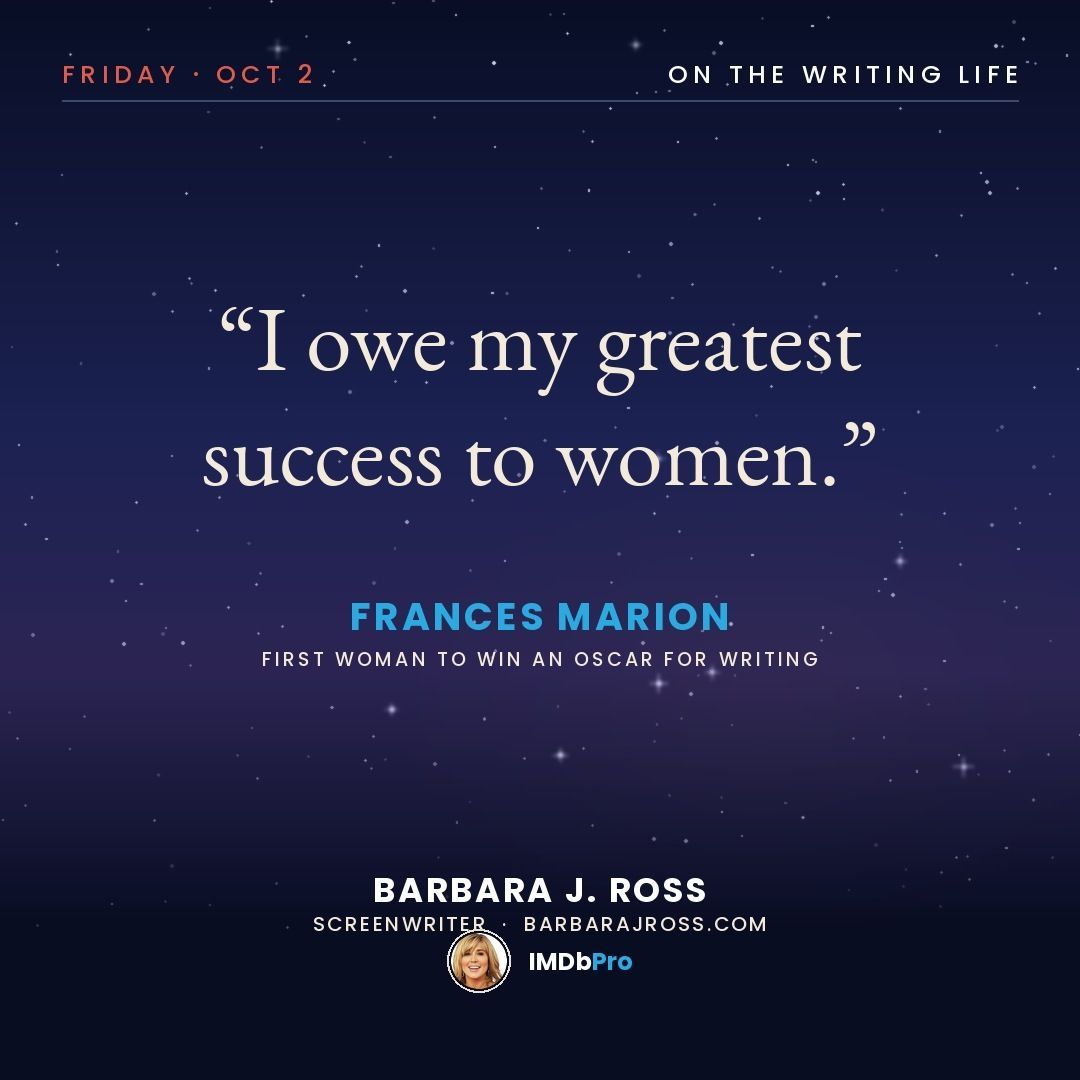
Quote card reading I owe my greatest success to women, Frances Marion, with a photo of screenwriter Barbara J. Ross
By Barbara J. Ross • October 2, 2026
Frances Marion was the highest paid screenwriter in Hollywood and the first woman to win an Oscar for writing. A woman gave her the first job.
Social card reading One Finds the Buyer, One Is the Buyer, with a photo of screenwriter Barbara J. Ross
By Barbara J. Ross • October 1, 2026
A sales agent works for you. A distributor is the buyer. Calling the wrong one first costs first-time filmmakers real money.
Social card reading 35% of Everything Except You, with a photo of screenwriter Barbara J. Ross
By Barbara J. Ross • September 30, 2026
California’s film credit now pays up to 35% on a $750 million pool. Writers are non-qualified spend, and here is why that still matters.
Social card reading NDA or Not to NDA, with a photo of screenwriter Barbara J. Ross
By Barbara J. Ross • September 29, 2026
Almost nobody will sign a writer’s NDA. What a submission release actually says, and where to protect the work instead.
Quote card: Above all, be the heroine of your life, not the victim - Nora Ephron, on the Barbara J. Ross screenwriting blog
By Barbara J. Ross • September 25, 2026
Nora Ephron told Wellesley graduates to be the heroine, not the victim. For screenwriters, that line is a business instruction, not a sentiment.
Light blue blog card reading Ticking Clocks, tagged On Screenwriting, with a photo of Barbara J. Ross
By Barbara J. Ross • September 24, 2026
A ticking clock is a deadline the audience can count. Not a mood, a number that gets smaller while they watch. A deadline with no consequence is a calendar.
Light blue blog card reading Scene Buttons, tagged On Screenwriting, with a photo of Barbara J. Ross
By Barbara J. Ross • September 23, 2026
A button is the last beat of a scene, the line that makes the cut feel decided. The best one is already in the scene, one beat before you stopped.
Light blue blog card reading Writing the Phone Call, tagged On Screenwriting, with a photo of Barbar
By Barbara J. Ross • September 22, 2026
A phone call takes away everything you usually use. It's only half a scene, and you write the other half: what each person does, and what each one can't see.
Light blue blog card reading Chain of Title, tagged On Business, with a photo of screenwriter Barbar
By Barbara J. Ross • September 21, 2026
Chain of title is the paper trail that proves who owns the story. If a lawyer can't draw a clean line from the idea to you, the script can't be bought.
Dark blue quote card reading A woman's best protection is a little money of her own, credited to Cla
By Barbara J. Ross • September 18, 2026
Clare Boothe Luce knew what it took to get into those rooms. Having your own money isn't about being rich. It's about being able to say no and to walk out.
Blog card reading Voiceovers, with a photo of screenwriter Barbara Ross on a dark blue background
By Barbara J. Ross • September 17, 2026
Voiceover isn't cheating, but captioning the frame is. Goodfellas and Sunset Boulevard show the difference, and one test tells you which one you wrote.
Blog card reading Writing the Sex Scene, with a photo of screenwriter Barbara Ross on a dark blue ba
By Barbara J. Ross • September 16, 2026
The good sex scenes are negotiations. Write the decision, not the choreography, and remember the agent and the line producer read the pages too.
Blog card reading What the Deal Memo Locks In, with a photo of screenwriter Barbara Ross on a dark b
By Barbara J. Ross • September 15, 2026
The deal memo takes an afternoon and the lawyers argue from it for a year. Credit, rewrite steps, bonus triggers, reversion: know your three before the call.
Blog card reading Know Who You're Pitching, with a photo of screenwriter Barbara Ross on a dark blue
By Barbara J. Ross • September 14, 2026
Lenders don't buy scripts. Fifteen minutes of research tells you whether the name on your desk is equity or debt, and whether your pitch has any chance.
Quote card reading They called you difficult, you were just the only one telling the truth, by Barbara J. Ross
By Barbara J. Ross • September 11, 2026
Difficult is what they call you when you ask who is paying and want the credit in writing. It describes the inconvenience, not your temperament.
Social card reading Writing Twists That Don't Cheat, with a photo of screenwriter Barbara J. Ross
By Barbara J. Ross • September 10, 2026
Withheld information is not a twist, it is a trick. A real twist uses what the audience already had and shows them they read it wrong.
Social card reading What's On the Nose, with a photo of screenwriter Barbara J. Ross
By Barbara J. Ross • September 9, 2026
On-the-nose dialogue kills a scene because it leaves the audience nothing to do. The fix is not vagueness. It is giving the character something else to want.
Social card reading What the Sales Agent Tells the Buyer, with a photo of screenwriter Barbara J. Ross
By Barbara J. Ross • September 8, 2026
The buyer asks who else is looking. That answer, not your draft, is what moves the number. What agents are really managing is scarcity.
Social card reading Tax Credits Producers Chase, with a photo of screenwriter Barbara J. Ross
By Barbara J. Ross • September 7, 2026
Georgia pays up to 30 percent back on qualified spend. That credit decides where your movie shoots, often before anyone reads your pages.
Quote card reading They told you it was too emotional, it was just true, by Barbara J. Ross
By Barbara J. Ross • September 4, 2026
Too emotional is the note you get when the scene is working and the room is uncomfortable. Keep the line. Cut the three around it that explain it.
Social card reading The Flashback That Earns an Interruption, with a photo of screenwriter Barbara J. Ross
By Barbara J. Ross • September 3, 2026
A flashback that only explains is a footnote. The one that works takes something the audience already watched and makes it mean the opposite.
Social card reading The Character Who Only Says Yes, with a photo of screenwriter Barbara J. Ross
By Barbara J. Ross • September 2, 2026
A character whose job is to agree cannot generate a scene. Give her a want that costs your protagonist something, or cut her lines entirely.
Social card reading The Back End Never Arrives, with a photo of screenwriter Barbara J. Ross
By Barbara J. Ross • September 1, 2026
Net profit is a defined term written by the people who have to pay it. Negotiate fixed compensation, production bonuses and gross-defined escalators instead.
Social card reading Turnaround Your Script Might Actually Survive, with a photo of screenwriter Barbara J. Ross
By Barbara J. Ross • August 31, 2026
Turnaround is not a death sentence. It is a number the next buyer has to clear before a single new page exists. Columbia put E.T. in turnaround.
Barbara J. Ross and her husband Mike, wearing festival badges, at the Catalina Film Festival
By Barbara J. Ross • October 3, 2023
At B Story Media, I go to film festivals to meet writers, producers and industry insiders. Catalina Film Festival is my favorite, and here's why.
Barbara J. Ross and a friend in a red dress laughing by the ocean
By Barbara J. Ross • May 22, 2023
Networking is hard for an introvert, but it's part of a writer's life. Here's how I prepare for writers' events, break the ice and follow up afterward.
A warm tungsten film lamp lights an empty velvet chaise and two untouched glasses on a dark set, the
By Barbara J. Ross • April 26, 2023
Lighting, framing, editing and color grading shape a scene's mood and subtext. Here's why I think screenwriters should write with the camera in mind.
Barbara J. Ross holding her Best Writer trophy at Austin Film Festival Under the Stars
By Barbara J. Ross • December 28, 2021
My rewrite of #WHATNEXT won Best Writer at Austin Film Festival Under the Stars, and the short also took the People's award. What a night!
Show More