A camera records what is there. A negative only plays when the absence has a visible shape.
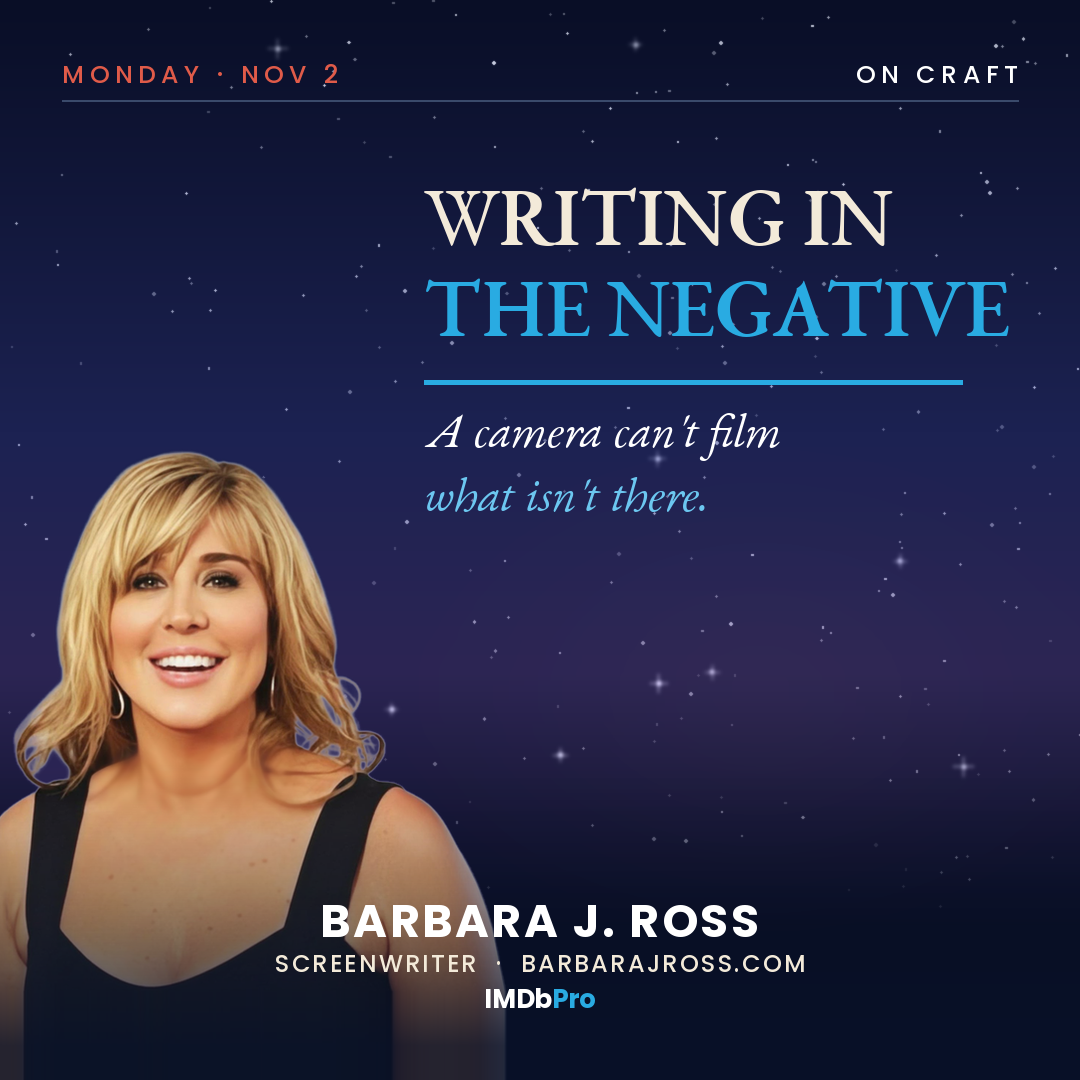
TL;DR. Because a camera records what is there and has no way to record an absence. A negative only plays when the absence has a visible shape, which is why "he doesn't move" works and "he doesn't trust her" doesn't. The fix is one question asked of every negative in your draft: what does the character do instead? Stillness, silence and an empty frame are the exceptions, because in those the absence is the event. Everywhere else a negative is you describing your intention instead of your character's behavior, and the worst version of it hides a decision the audience never gets to watch.
What's actually wrong with a negative action line?
It isn't grammar. It's that there's nothing to point the camera at.
Take three lines out of a first draft. He doesn't trust her. She isn't listening. The room doesn't feel safe. Each one is true, each one is useful to you, and not one of them can be photographed. A camera records what is in front of it. Absence has no image until you give it one.
Compare that with he doesn't move. That plays, because stillness is a thing you can see a person doing. The difference isn't the word doesn't. It's whether the thing being denied has a body.
What's the question that fixes it?
What does she do instead. That's the whole repair, and it works on almost every line.
She doesn't trust him becomes she keeps the table between them. He isn't listening becomes he checks the clock twice while she talks. She doesn't want to go becomes she finds one more thing to put in her bag.
Same information both ways. One version is a note to yourself about what you meant. The other is a scene an actor can play and a camera can shoot. And the second version is usually more specific than the first, because you had to decide what the distrust looks like in this room, with this table, between these two people.
What does the lean version look like in a produced script?
No Country for Old Men. Joel and Ethan Coen wrote and directed it, adapting Cormac McCarthy's novel, and their action lines are about as lean as American screenwriting gets.
One of them, for Carson Wells, reads: "He rests a booted foot across one knee." Nine words. Every one of them names something a camera can see. Nobody tells you what he's feeling, and you know anyway, because the ease is in the boot and the knee.
That's the trade. You give up the ability to state the interior, and you get a reader who arrives at it themselves, which is the only way it ever really lands.
When does a negative actually work?
Three cases, and they have one thing in common.
Stillness. Nobody moves. The absence of movement is visible, so the line plays.
Silence. She doesn't answer. Same logic. The pause is the event, and a reader hears it.
The empty frame. The street is empty. Emptiness is what the shot is of, so there's something to look at.
In all three, the absence has become the subject. That's the test. If the thing missing is what we're watching, write the negative. If the thing missing is an idea in your head, write the behavior.
What's the expensive version of this mistake?
Negatives hide decisions, and that's the one I'd flag hardest.
He doesn't kill her isn't a choice on screen. It's a non-event. Lowering the gun is a choice, and so is thumbing the safety back on, and so is turning and walking out of the room while she's still standing there.
If your character chooses not to do something, the choice has to happen in front of us or it didn't happen. Write the moment. Otherwise you've put the single most important beat in your scene inside a word the audience can't see.
The same applies at scale. A character who doesn't tell the truth, across a whole second act, is a character who is doing something else in every one of those scenes. Figure out what, and you've got your scenes.
Does this mean action lines should have no feeling in them?
No, and this is where the rule gets misread.
You're allowed to pick the detail that carries the feeling. Writing "she keeps the table between them" is not neutral. You chose a table, you chose the word keeps, and both of those are doing emotional work. What you're giving up is the shortcut of naming the emotion and moving on.
The version that reads as writerly is the one where the line says what nobody can see and then stops, because the writer is talking to the reader over the character's head. It stops the movie for exactly as long as it sits there, and a reader who was inside the scene is now outside it, reading.
How do you run the pass?
Mechanically, and it takes an hour.
Search the draft for doesn't, isn't, won't, no longer, nothing and never. Look only in the action lines, since dialogue is allowed to be negative all day. For each hit, ask what the camera is pointed at while that line is true. If the honest answer is nothing, replace it with behavior. If the answer is stillness, silence or an empty space, leave it alone.
Then look at what the replacements cost you in length. Most of them will be shorter, because "she keeps the table between them" is six words and the paragraph you would have written around "she doesn't trust him" is forty.
Before your next pass, run this checklist
Have I searched the action lines for doesn't, isn't, won't, no longer, nothing and never?
For each one, can I name what the camera is looking at?
Where the answer is nothing, do I know what the character does instead?
Is the absence the event in the ones I kept, or am I just attached to the line?
Is there a decision anywhere in my draft written as something a character doesn't do?
Have I named an emotion in an action line that the behavior underneath it already shows?
Is my replacement specific to this room and these two people, or would it fit any scene?
Did the pass make the pages shorter, and if it didn't, what did I add?
A camera has never once recorded a thought, which is why everything you want an audience to understand has to arrive as something somebody does. Open your draft, search for doesn't, and fix the first ten you find.
---
Sources. No Country for Old Men was written and directed by Joel and Ethan Coen from Cormac McCarthy's novel, per the film's Wikipedia entry; the action line quoted for Carson Wells is from the published screenplay. Everything else here is the rule as I apply it to my own drafts.