Reach on a social platform is rented, and a list is owned.
TL;DR. Because reach on a social platform is rented and a list is owned. Organic reach on the big feeds now runs in the low single digits of your followers, while email open rates sit around 15 to 25 percent, and the inbox doesn't reshuffle itself when a product team changes its mind. Platforms also disappear: Vine had more than 200 million active users and was gone inside a few months, and TikTok went dark in the United States for about a day in January 2025. For a screenwriter the argument is timing, because festivals, competitions and project launches land on dates you don't control. Mine is monthly, one email, and I'm not selling anything.

I'm starting a newsletter. Two things go in it. The craft work that doesn't fit in a post, where I have room to put the actual pages up and walk through why a scene lands or doesn't. And the behind the scenes, which right now means a screenplay in competition at a festival, learning to produce, and building a company while I do both.

What it isn't. It's not a digest of industry headlines you already saw. It's not a funnel for a course. I'm not selling you anything, and if that ever changes I'll tell you in the first line, not the twelfth.

What actually happens when a platform disappears?

Vine is the cleanest case. By December 2015 it had more than 200 million active users. Twitter announced in October 2016 that it would turn off uploads, the app shut down in January 2017, and the archive Twitter built for everyone's videos was itself discontinued in April 2018. The decline started before the shutdown: between January and June 2016, more than half of Vine users with over 15,000 followers stopped uploading or deleted their accounts.

It doesn't take a shutdown, either. In January 2025 TikTok went dark in the United States for roughly fourteen hours while a divest-or-ban law took effect, and for a day nobody with an audience there could reach it. Google ran a social network for eight years and closed it. None of these were punishments. They were business decisions made by people who never heard of you, and everybody who had built on top of them absorbed the cost.

An account can also just stop working for you personally. A hacked login, a mistaken policy strike, a name mix-up in an automated review. Whatever the cause, the followers don't come with you, because they were never yours to move.

How many people are really seeing a post?

Fewer than the follower count suggests. Published benchmarks put organic reach around 4 percent on Instagram and around 2 percent on Facebook, so a post reaches a small slice of the people who already chose to follow you. Email runs differently. Open rates typically land in the 15 to 25 percent range, click-through sits near 2.9 percent against about 1.36 percent for social, and the comparisons that price it out land around $36 returned per dollar on email versus roughly $2.80 on social.

I'm not running a campaign, so the ROI figure isn't the point for me. The ratio is. A monthly email read by two hundred people who asked for it does more real work than a post shown to two thousand strangers scrolling past.

There's also a ceiling on length. Instagram caps captions at 2,200 characters and LinkedIn's post limit is 3,000. Some of what's most worth saying takes four thousand words and a few pages of script open next to it, and no feed post holds that.

Why does a list matter more for a screenwriter than for most people?

Because our calendar is set by other people. Festival results land on a date the festival picks. Quarterfinalist lists go up when the competition posts them. A film gets a release window, a novel gets a pub date, a project gets announced the morning a trade decides to run it. Those are the moments when having somewhere to say something matters most, and they're exactly the ones you can't schedule around an algorithm's mood.

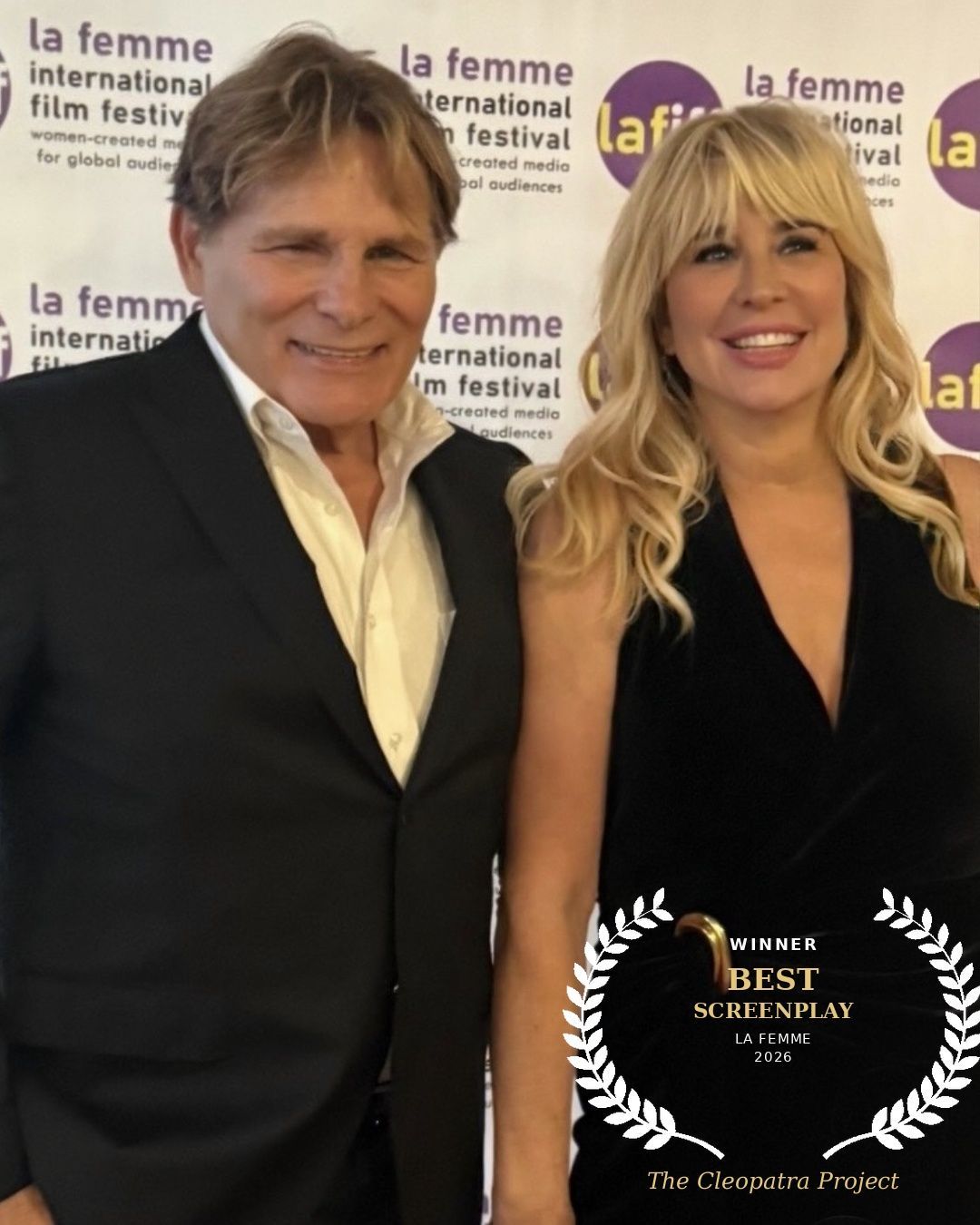
I have a spy thriller novel out with an agent and a screenplay that went into a festival this fall. If either turns into news, I want to tell people directly rather than hope a feed decides that day's post deserves distribution. That's the entire function. It isn't a growth strategy, it's a working phone line.

And I'll be straight about the other reason. I don't own this platform. Neither do you. A list is the one piece of this that's actually mine, and after the year this industry has had, with Los Angeles on-location production finishing 2025 down 16.1 percent, that matters to me more than it used to.

Isn't a newsletter just a second job?

It is if you design it that way. What kills most writers' newsletters isn't lack of interest, it's a cadence they can't hold. Weekly means roughly fifty deadlines a year on top of your actual pages.

Monthly is twelve. That's the whole trick. One email, no series, no supplementary posts, no promise of a specific day. If I'm on a deadline it goes out late, and nobody who signed up for a working writer's newsletter will be surprised by that.

The other half is refusing the machinery. No welcome sequence, no segmentation, no tagging people by behavior, no automation to maintain. Most providers have a free tier that covers a few hundred to a few thousand addresses, and the only real ongoing cost is the hour or two it takes to write the thing. A newsletter becomes a job when you start optimizing it, and I'm not going to.

Is it legal to add people who just email me, with no form and no double opt-in?

Yes, and it's worth knowing why. In the United States, CAN-SPAM is an opt-out law, not an opt-in law, and it doesn't require prior consent or a confirmation click. What it does require is a working unsubscribe, honored within 10 business days and functional for at least 30 days after the email goes out, honest headers and subject lines, and a valid physical postal address in every commercial message. A P.O. box registered with the USPS counts, which matters if you work from home. The penalties are real: as of October 2026 the FTC's figure is up to $53,088 per violating email.

Two notes on top of the law. Since 2024, Gmail and Yahoo have required bulk senders to support one-click unsubscribe headers and keep spam complaints below 0.3 percent, so a clean unsubscribe is what keeps you landing in inboxes at all. And if anyone on your list is in the EU or UK, GDPR does want affirmative consent, so somebody emailing to ask in is the kind of record you want to keep.

Which is a long way of saying: three ways to get on mine. Comment with the word newsletter, message me, or email me at barbara@barbarajross.com. There's a signup at barbarajross.com too. No form you have to survive, no double opt-in, no confirm your humanity. Leave whenever you want and I won't make it difficult.

Before you start one, run this checklist

What cadence can I actually hold in a bad month, and have I promised anything faster than that?

What goes in it that genuinely can't fit in a post, and do I have three of those ready?

Do I have a postal address I'm willing to publish, or a P.O. box?

Is my unsubscribe one click, and will I honor it the day it arrives?

Where does the list itself live, and can I export it tomorrow if I leave that provider?

If my main account vanished tonight, how many of these people could I still reach?

Am I building this to sell something later, and if so, am I willing to say that in the first email?

If you've been reading these and getting something out of them, come with me. If you're a writer sitting on an unfinished script, you're exactly who I'm writing it for, and I'd rather reach you on a line neither of us can lose.

---

Sources. Vine's user figure, shutdown timeline, archive closure and the 2016 creator attrition number come from the Wikipedia entry on Vine. The January 2025 TikTok outage is from TechCrunch and NBC News coverage of the divest-or-ban deadline. Organic reach figures, the email open and click-through ranges and the ROI comparison are from EmailTooltester's email versus social media analysis, which cites SocialInsider, Social Status, Campaign Monitor and Statista. CAN-SPAM requirements, the per-email penalty figure current as of October 2026 and the Gmail and Yahoo bulk sender rules come from NewsletterReady's CAN-SPAM guide and the FTC compliance guide it cites. The Los Angeles production decline is FilmLA's full-year 2025 report via Deadline. Character limits are Instagram's and LinkedIn's published caps. My own cadence and what goes in the newsletter are mine.
By Barbara Ross • November 1, 2026
A spending quota changes how much money moves, not who the buyer can already find.
By Barbara Ross • October 31, 2026
Pick one dark trait as the engine, write the other two weaker, and give them something they are good at.
By Barbara Ross • October 30, 2026
Two Virginia Woolf lines going around right now are not hers, and the real one is better.
By Barbara Ross • October 29, 2026
They decide what your movie looks like, and you hire one in prep, earlier than you think.
By Barbara Ross • October 28, 2026
Most of them do nothing for your career and a few do everything, and the difference is who is in the building.
By Barbara Ross • October 27, 2026
It's a rights market, not a script market, so a spec has nothing to transact there.
By Barbara Ross • October 23, 2026
She stopped waiting for better parts and built a company to make her own.
By Barbara Ross • October 21, 2026
You already are one, whether you admit it or not.
By Barbara Ross • October 20, 2026
Find out whether you have a story-length problem or a writing-length problem before you cut anything.
By Barbara Ross • October 19, 2026
Build the midpoint as a rehearsal for the ending, the same choice at a lower price.
By Barbara Ross • October 16, 2026
Being first is timing and somebody's open door. Lasting is the craft.
By Barbara Ross • October 15, 2026
Repetition is how you teach an audience the rules of your story, and an audience that knows the rules can run ahead of you.
By Barbara Ross • October 14, 2026
The affair confrontation is an information scene, and the first line out of the guilty character's mouth is a question.
By Barbara Ross • October 13, 2026
There are two kinds of fake ticking clock, and they run on different rules.
By Barbara Ross • October 13, 2026
A package is what lets somebody else write a check. The cast list is the piece that moves the number.
By Barbara Ross • October 9, 2026
The citation says new forms, which means the unclassifiable part is the part they rewarded.
Social card for the post, screenwriter Barbara J. Ross beside the headline She Was First. That Wasn'
By Barbara J. Ross • October 9, 2026
Anita Loos was the first woman staff screenwriter in Hollywood. The more interesting fact is the sixty eight years of work that came after.
Social card for the post, screenwriter Barbara J. Ross beside the headline Intercutting Scenes
By Barbara J. Ross • October 8, 2026
An intercut is not a transition. Three questions that tell you whether you have one, with The Godfather and The Silence of the Lambs as proof.
Social card for the post, screenwriter Barbara J. Ross beside the headline Writing the Text Message
By Barbara J. Ross • October 7, 2026
Text scenes fail when you write the transcript. Write the gap instead: the typing indicator, the delete, the message nobody answers.
Social card for the post, screenwriter Barbara J. Ross beside the headline The Oldest Thing in the F
By Barbara J. Ross • October 6, 2026
Your opening scene is the oldest thing in the file. Four questions to ask it, with The Godfather and Sunset Boulevard as the working examples.
Social card for the post, screenwriter Barbara J. Ross beside the headline Do You Pay the Sales Agent and the Distributor?
By Barbara J. Ross • October 5, 2026
Part two on film sales: when a sales agent commissions the license fee, when a distributor's margin is already priced in, and where the fees stack.
Quote card reading I owe my greatest success to women, Frances Marion, with a photo of screenwriter Barbara J. Ross
By Barbara J. Ross • October 2, 2026
Frances Marion was the highest paid screenwriter in Hollywood and the first woman to win an Oscar for writing. A woman gave her the first job.
Social card reading One Finds the Buyer, One Is the Buyer, with a photo of screenwriter Barbara J. Ross
By Barbara J. Ross • October 1, 2026
A sales agent works for you. A distributor is the buyer. Calling the wrong one first costs first-time filmmakers real money.
Social card reading 35% of Everything Except You, with a photo of screenwriter Barbara J. Ross
By Barbara J. Ross • September 30, 2026
California’s film credit now pays up to 35% on a $750 million pool. Writers are non-qualified spend, and here is why that still matters.
Social card reading NDA or Not to NDA, with a photo of screenwriter Barbara J. Ross
By Barbara J. Ross • September 29, 2026
Almost nobody will sign a writer’s NDA. What a submission release actually says, and where to protect the work instead.
Quote card: Above all, be the heroine of your life, not the victim - Nora Ephron, on the Barbara J. Ross screenwriting blog
By Barbara J. Ross • September 25, 2026
Nora Ephron told Wellesley graduates to be the heroine, not the victim. For screenwriters, that line is a business instruction, not a sentiment.
Light blue blog card reading Ticking Clocks, tagged On Screenwriting, with a photo of Barbara J. Ross
By Barbara J. Ross • September 24, 2026
A ticking clock is a deadline the audience can count. Not a mood, a number that gets smaller while they watch. A deadline with no consequence is a calendar.
Light blue blog card reading Scene Buttons, tagged On Screenwriting, with a photo of Barbara J. Ross
By Barbara J. Ross • September 23, 2026
A button is the last beat of a scene, the line that makes the cut feel decided. The best one is already in the scene, one beat before you stopped.
Light blue blog card reading Writing the Phone Call, tagged On Screenwriting, with a photo of Barbar
By Barbara J. Ross • September 22, 2026
A phone call takes away everything you usually use. It's only half a scene, and you write the other half: what each person does, and what each one can't see.
Light blue blog card reading Chain of Title, tagged On Business, with a photo of screenwriter Barbar
By Barbara J. Ross • September 21, 2026
Chain of title is the paper trail that proves who owns the story. If a lawyer can't draw a clean line from the idea to you, the script can't be bought.
Dark blue quote card reading A woman's best protection is a little money of her own, credited to Cla
By Barbara J. Ross • September 18, 2026
Clare Boothe Luce knew what it took to get into those rooms. Having your own money isn't about being rich. It's about being able to say no and to walk out.
Blog card reading Voiceovers, with a photo of screenwriter Barbara Ross on a dark blue background
By Barbara J. Ross • September 17, 2026
Voiceover isn't cheating, but captioning the frame is. Goodfellas and Sunset Boulevard show the difference, and one test tells you which one you wrote.
Blog card reading Writing the Sex Scene, with a photo of screenwriter Barbara Ross on a dark blue ba
By Barbara J. Ross • September 16, 2026
The good sex scenes are negotiations. Write the decision, not the choreography, and remember the agent and the line producer read the pages too.
Blog card reading What the Deal Memo Locks In, with a photo of screenwriter Barbara Ross on a dark b
By Barbara J. Ross • September 15, 2026
The deal memo takes an afternoon and the lawyers argue from it for a year. Credit, rewrite steps, bonus triggers, reversion: know your three before the call.
Blog card reading Know Who You're Pitching, with a photo of screenwriter Barbara Ross on a dark blue
By Barbara J. Ross • September 14, 2026
Lenders don't buy scripts. Fifteen minutes of research tells you whether the name on your desk is equity or debt, and whether your pitch has any chance.
Quote card reading They called you difficult, you were just the only one telling the truth, by Barbara J. Ross
By Barbara J. Ross • September 11, 2026
Difficult is what they call you when you ask who is paying and want the credit in writing. It describes the inconvenience, not your temperament.
Social card reading Writing Twists That Don't Cheat, with a photo of screenwriter Barbara J. Ross
By Barbara J. Ross • September 10, 2026
Withheld information is not a twist, it is a trick. A real twist uses what the audience already had and shows them they read it wrong.
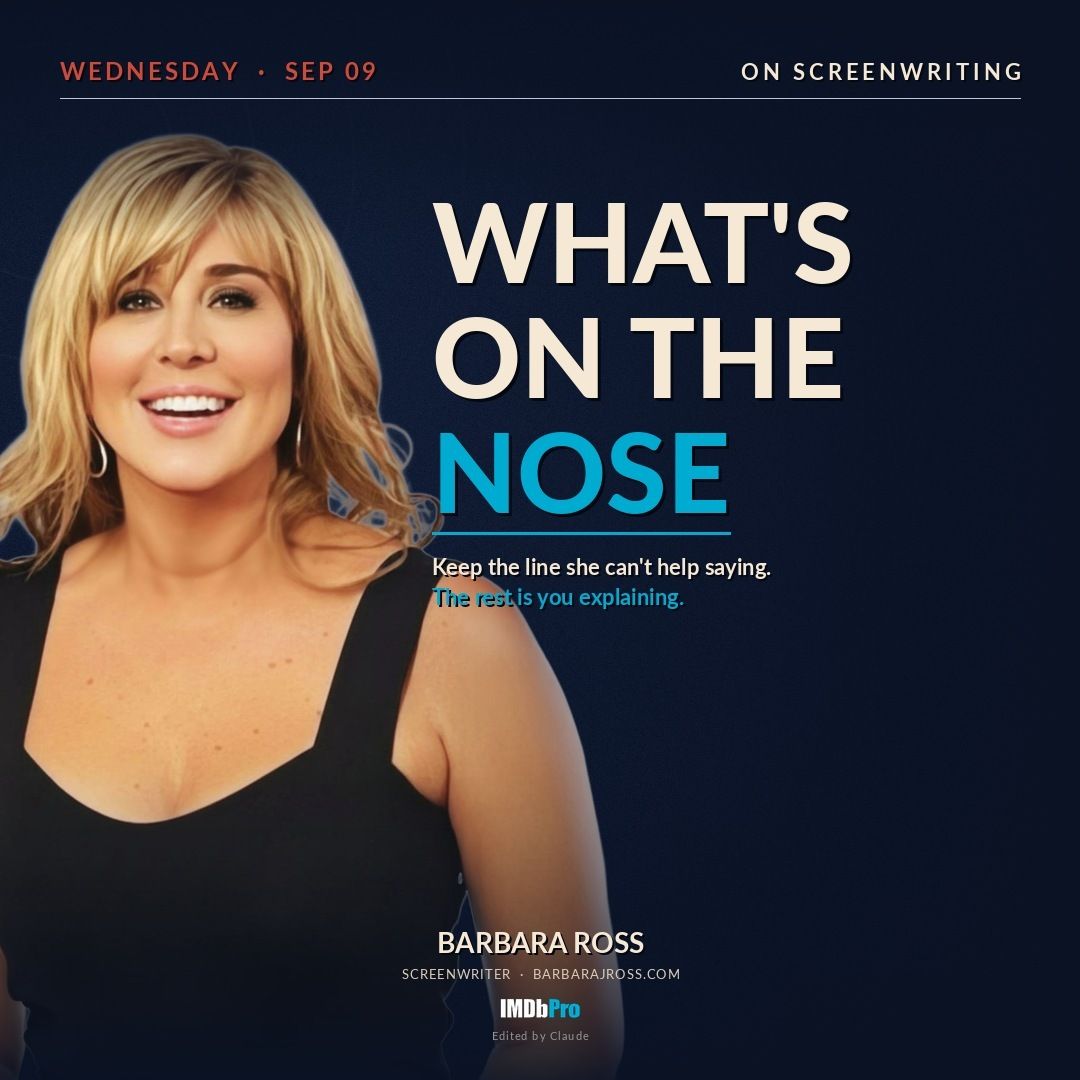
Social card reading What's On the Nose, with a photo of screenwriter Barbara J. Ross
By Barbara J. Ross • September 9, 2026
On-the-nose dialogue kills a scene because it leaves the audience nothing to do. The fix is not vagueness. It is giving the character something else to want.
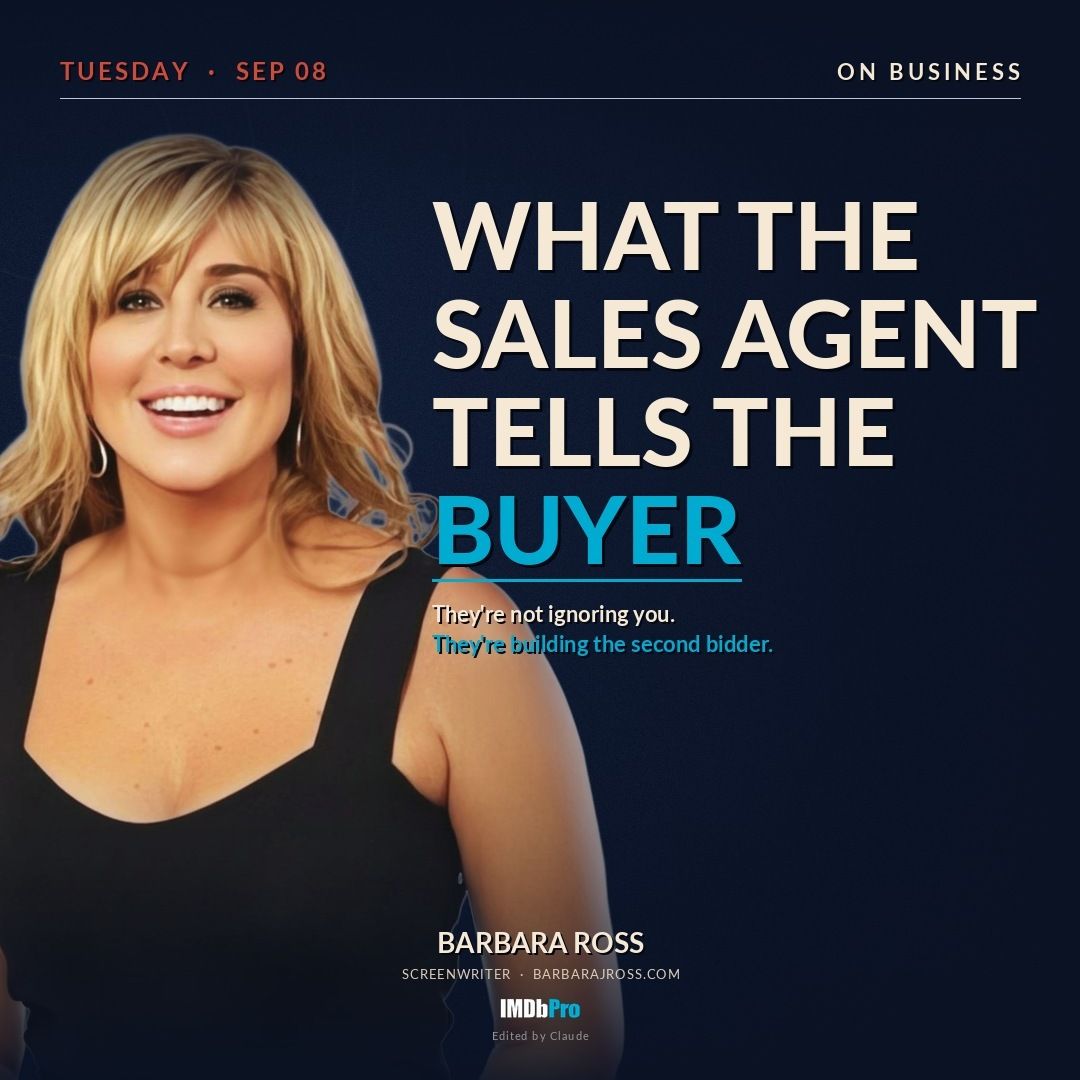
Social card reading What the Sales Agent Tells the Buyer, with a photo of screenwriter Barbara J. Ross
By Barbara J. Ross • September 8, 2026
The buyer asks who else is looking. That answer, not your draft, is what moves the number. What agents are really managing is scarcity.
Social card reading Tax Credits Producers Chase, with a photo of screenwriter Barbara J. Ross
By Barbara J. Ross • September 7, 2026
Georgia pays up to 30 percent back on qualified spend. That credit decides where your movie shoots, often before anyone reads your pages.
Quote card reading They told you it was too emotional, it was just true, by Barbara J. Ross
By Barbara J. Ross • September 4, 2026
Too emotional is the note you get when the scene is working and the room is uncomfortable. Keep the line. Cut the three around it that explain it.
Social card reading The Flashback That Earns an Interruption, with a photo of screenwriter Barbara J. Ross
By Barbara J. Ross • September 3, 2026
A flashback that only explains is a footnote. The one that works takes something the audience already watched and makes it mean the opposite.
Social card reading The Character Who Only Says Yes, with a photo of screenwriter Barbara J. Ross
By Barbara J. Ross • September 2, 2026
A character whose job is to agree cannot generate a scene. Give her a want that costs your protagonist something, or cut her lines entirely.
Social card reading The Back End Never Arrives, with a photo of screenwriter Barbara J. Ross
By Barbara J. Ross • September 1, 2026
Net profit is a defined term written by the people who have to pay it. Negotiate fixed compensation, production bonuses and gross-defined escalators instead.
Social card reading Turnaround Your Script Might Actually Survive, with a photo of screenwriter Barbara J. Ross
By Barbara J. Ross • August 31, 2026
Turnaround is not a death sentence. It is a number the next buyer has to clear before a single new page exists. Columbia put E.T. in turnaround.
Barbara J. Ross and her husband Mike, wearing festival badges, at the Catalina Film Festival
By Barbara J. Ross • October 3, 2023
At B Story Media, I go to film festivals to meet writers, producers and industry insiders. Catalina Film Festival is my favorite, and here's why.
Barbara J. Ross and a friend in a red dress laughing by the ocean
By Barbara J. Ross • May 22, 2023
Networking is hard for an introvert, but it's part of a writer's life. Here's how I prepare for writers' events, break the ice and follow up afterward.
A warm tungsten film lamp lights an empty velvet chaise and two untouched glasses on a dark set, the
By Barbara J. Ross • April 26, 2023
Lighting, framing, editing and color grading shape a scene's mood and subtext. Here's why I think screenwriters should write with the camera in mind.
Barbara J. Ross holding her Best Writer trophy at Austin Film Festival Under the Stars
By Barbara J. Ross • December 28, 2021
My rewrite of #WHATNEXT won Best Writer at Austin Film Festival Under the Stars, and the short also took the People's award. What a night!
#WHATNEXT poster for Austin Under the Stars 2021, comedy, directed by Stanislava Ivy
By Barbara J. Ross • October 7, 2021
#WHATNEXT, starring Marietta Melrose, was invited to screen at Austin Film Festival Under the Stars. I rewrote the script for this comedy short.
Show More