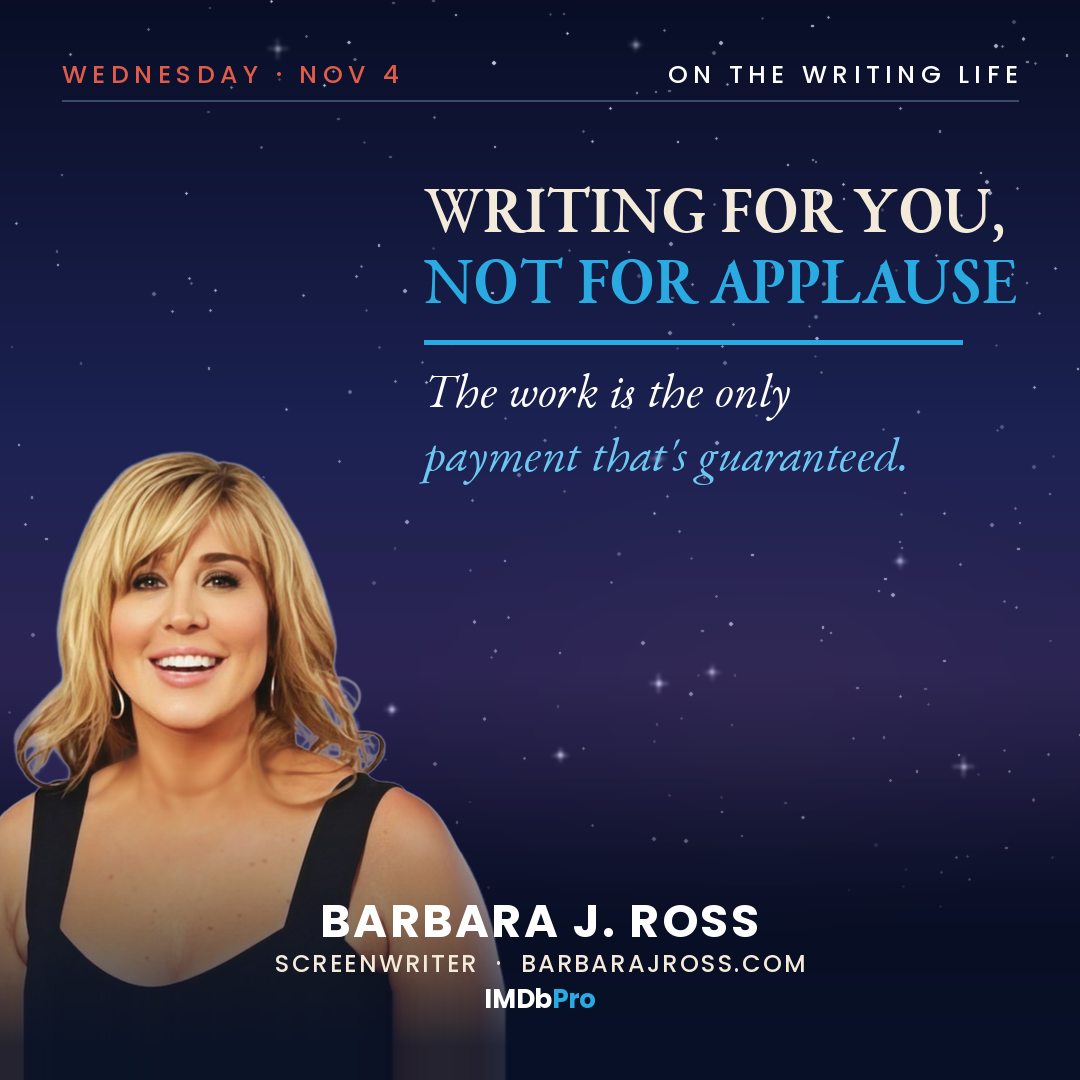
The work itself is the only payment you're guaranteed.
TL;DR. The audience isn't the problem. You want them, and anybody who says otherwise is performing something. The problem starts when you write while expecting something back from them, because the thing you're picturing is made of other people's reactions and those were never yours to control. Kurt Vonnegut's seventh rule, from the preface to Bagombo Snuff Box, is to write to please just one person, and that rule works just as well when the one person is you. The test I use is whether I'd still be glad I wrote it if nothing came of it. If the answer is no, something is off, because the work itself is the only payment you're guaranteed.
What exactly goes wrong when you write for applause?
You stop writing the scene and start writing toward a picture.
You picture the room laughing at that line. You picture the manager calling. You picture the review, the quote-tweet, the festival announcement. Then you write toward the picture, and the picture is assembled entirely out of reactions you don't own. A manager's inbox, a reader's mood on a Tuesday, a programmer's slate for the year. None of that is available to you while you're typing.
What is available is whether the pages came out the way you wanted them. That's the one input in this whole business you actually control, and if you spend it chasing the picture you've spent the only thing you had.
What did Vonnegut actually say?
His seventh rule for writing short stories, in the preface to Bagombo Snuff Box, is to write to please just one person. The line everyone quotes is the one about the window: if you open a window and make love to the world, your story will get pneumonia.
Most people read that as advice about picking a reader. Write for your sister. Write for the friend who likes the thing you like. Pick somebody with a face and write to them, so the prose stops hedging.
It works that way, and it works just as well when the one person is you. A story written to please one specific reader has a point of view, because pleasing one person means choosing, and choosing is where voice comes from. A story written to please everyone has to hedge every choice, which is the pneumonia.
How do you know whether you're doing it?
The test is one question.
If nothing happens with this script, no sale, no contest, no call, would I still be glad I wrote it?
If the answer is yes, keep going. If the answer is no, something's off, and it's usually locatable. Either the project was chosen for the market rather than for you, or the draft got bent somewhere to land a reaction, or you've been writing for so long with the picture in your head that you can't remember what you wanted from the thing in the first place.
Isn't that just resignation?
Call it that if you want. It's also the version of this job you can survive.
The rejections keep coming either way. That isn't pessimism, it's arithmetic, and anyone who's been submitting for more than a year knows it. The question is what state you're in when they arrive.
A writer whose satisfaction lives inside somebody else's response has handed it to people who mostly aren't thinking about them at all. Not out of malice. A reader with four hundred unread submissions is not withholding anything from you, they're just somewhere else. If your sense of whether the work was worth doing depends on them, you've put it in a place neither of you can reach.
And the practical version of that is attrition. The writers who stop are rarely the ones without talent. They're the ones whose fuel was external, and the external supply ran out, as it does for nearly everybody for long stretches.
Does writing for yourself actually read better?
It does, and that's the part that surprises people.
Work made to satisfy the person who made it has a point of view in it, because somebody decided things. Work made to earn a reaction keeps glancing over its shoulder, and readers feel that even when they can't name it. They'll call it safe, or thin, or say it doesn't commit. What they're responding to is a draft where every choice was hedged against an imagined objection.
The strange and specific thing you put in because you wanted it there is usually the thing somebody quotes back to you. The thing you put in because you thought it was what they wanted is usually the thing they skim.
So what do you do with the ambition?
Keep it, and put it somewhere it can't contaminate the page.
Ambition belongs to the business half of this. Submitting, tracking, building relationships, learning the money, getting the work in front of people. All of that is real work, it's supposed to be goal-directed, and it should be scheduled.
The writing half gets a different rule. While you're in the pages, the only question is whether this is the thing you meant. Mixing the two is what produces a draft nobody committed to, and a writer who can't tell whether a bad week means the script is wrong or the market is slow.
The practical version is literal. Different hours, and ideally a different place to sit.
Before your next pass, run this checklist
If nothing came of this, would I be glad I wrote it?
What's in here because I wanted it there?
What's in here because I pictured somebody approving?
What would I put back if nobody was ever going to read it?
Who is the one person I'm writing this for, and can I name them?
Where in the draft did I hedge a choice against an objection nobody has made yet?
Am I doing the business half in the same hours as the writing half?
When I last got a rejection, what exactly did it change about how I felt about the work itself?
Start with the question about what you'd put back. It's usually the good stuff, and it's usually still sitting in a file somewhere with a name like notes or cut. Go find it, read it, and see whether it belongs back in the draft.
---
Sources. Kurt Vonnegut's eight rules for writing short stories, including the seventh rule to write to please just one person and the line about opening a window and getting pneumonia, are from his preface to the 1999 story collection Bagombo Snuff Box. Everything else here is mine.