Octavia Butler wrote it to herself in 1988, twenty years into rejection slips and temp jobs.
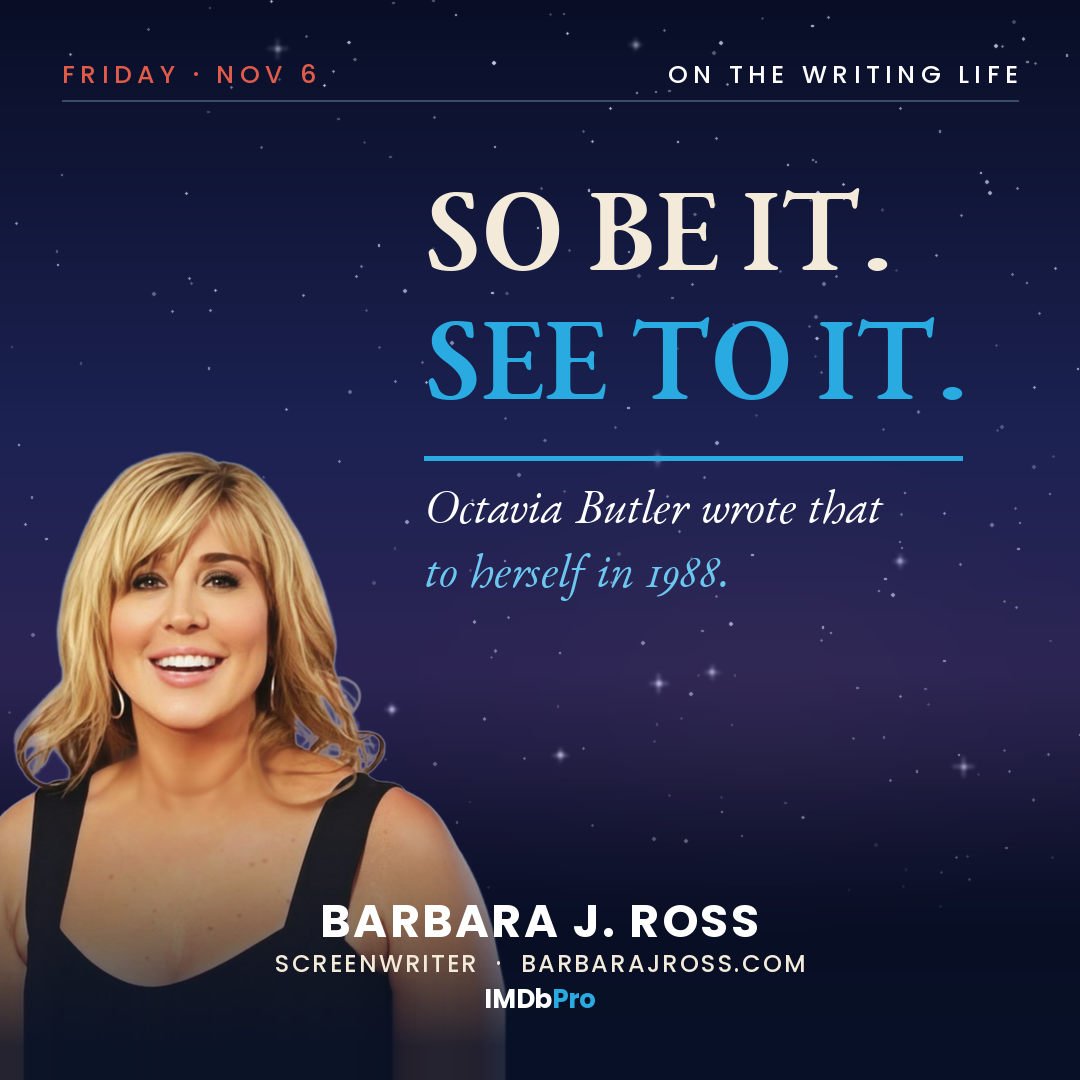
"My books will be read by millions of people! So be it! See to it!"
Octavia E. Butler wrote that in her own notebook in 1988. Not in an interview, not in a speech. A page of notes to herself, and on the original that last line is bigger than everything above it.
That's the part I keep coming back to. She wasn't saying it to anybody.
Where she was when she wrote it
She'd been publishing for over a decade by 1988 and she was nowhere near millions of readers.
She sold her first story and then, in her own words, had "five more years of rejection slips and horrible little jobs ahead of me before I sold another word." The jobs were deliberate. She took dull work on purpose, the kind that didn't ask anything of her, because she needed the good part of her brain for the writing. Then she got up before dawn and wrote. Three in the morning, four in the morning, before the shift started.
That went on until 1978.
And she was a Black woman writing science fiction in a field that had almost none of either. None of this was happening on a level floor, and she knew it.
So by 1988 she had a career. She did not have the career on that notebook page.
It isn't a vision board
I want to be careful here, because this quote gets passed around as manifesting, and that flattens it into something it isn't.
Manifesting says the wanting does the work. What Butler wrote down was a decision, and then she went and spent another twenty years acting on it. The sentence is the smallest part of the story. The getting up at four in the morning is the story.
On that same list, by the way, right in among the sales figures and the goals, she wrote that she would send poor Black kids to Clarion and other writers' workshops. Same page. Same certainty. She never treated that one as the soft goal, the nice-to-have you put at the bottom. It sat with the rest.
Look at how it went
The Hugo in 1984, for Speech Sounds.
The Nebula the same year, for Bloodchild.
The MacArthur in 1995, the first one ever given to a science fiction writer.
And here's the one that gets me. Parable of the Sower made the New York Times bestseller list in September 2020. Her first time on that list, ever, fourteen years after she died.
She was right. It just took longer than the sentence makes it sound, and she didn't get to see most of it.
The tense
Here's what I actually take from her, and it's a small technical thing, which is probably why it's useful.
Look at the verbs. She didn't write that she hoped. She didn't write that it might happen someday, or that she'd like to get there eventually. She wrote it in the tense of a thing already settled. My books will be read. So be it. See to it.
See to it is an instruction. She's giving herself an order.
I think there's something real in that, and it isn't mystical. When you write a goal as a wish, you leave yourself room to not do it, and you will use that room. When you write it as a decision you've already made, the only question left in front of you every morning is what today's piece of it is.
That's not magic. That's just removing an exit.
If you're in the rejection years
Some of you reading this are in the long stretch. The one that's running longer than anybody warned you it would. You've got the pages and you've got the rejections and you don't have the evidence yet.
Butler had twenty years of that and wrote the sentence anyway.
So write yours down. In the tense you don't have any evidence for. Not because the universe is listening, but because you are, and because a decision behaves differently in your own head than a hope does.
Then get up tomorrow and do the piece of it that's actually in front of you.
So be it. See to it.
The notebook page is in the Octavia E. Butler papers at the Huntington Library in San Marino, California, and is reproduced in Lynell George's A Handful of Earth, A Handful of Sky: The World of Octavia E. Butler.
The "five more years of rejection slips" line is Butler's own, about the stretch after her first sale. She stopped taking temp work in 1978, won the Hugo for Speech Sounds and the Nebula for Bloodchild in 1984, and received the MacArthur Fellowship in 1995. Parable of the Sower entered the New York Times bestseller list in September 2020, her first appearance on it.